Energy-efficient Chemical Systems Research Group
Based on life cycle assessment (LCA), the Energy-efficient Chemical Systems Research Group develops methodologies to design and evaluate optimal chemical processes from both CO2 emissions and economic perspectives. By applying multi-criteria evaluations—including CO2 emissions, production costs, and resource circulation rates—we accelerate the development of elemental technologies for materials and processes, contributing to the realization of the circular economy and CCUS.
Main Research Subjects
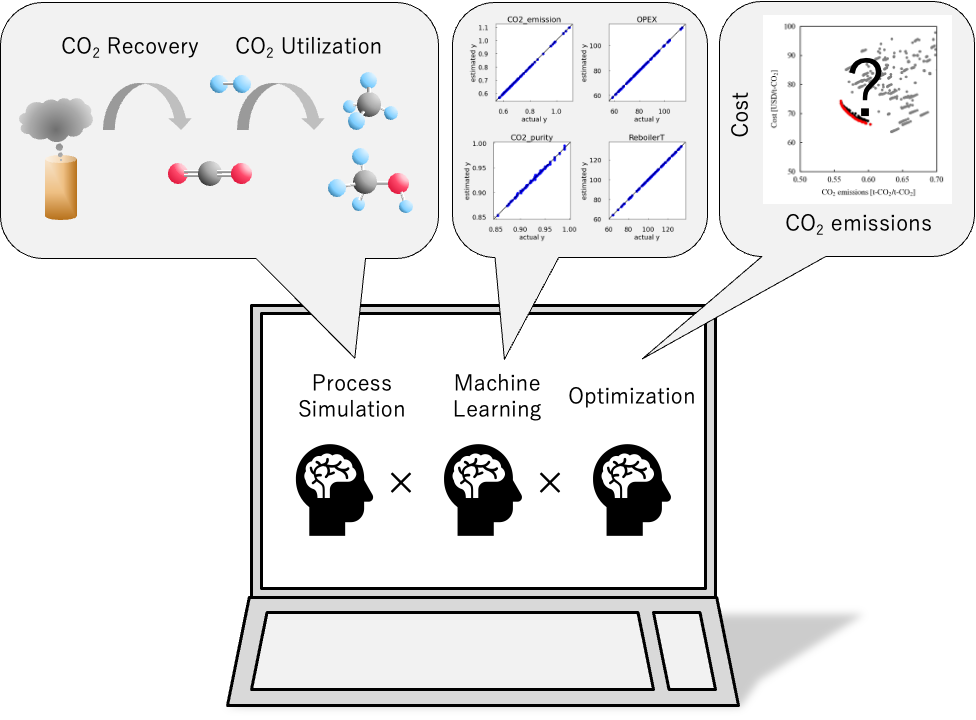
1. Development of multi-objective optimization methods for CCUS processes
We conduct process simulations and multi-objective optimization of carbon capture, utilization, and storage (CCUS) processes, focusing on cost and CO2 emissions. By setting parameters such as electricity, heat, and hydrogen prices, as well as CO2 emission factors, we analyze optimal equipment configurations and operating conditions across CCUS processes.
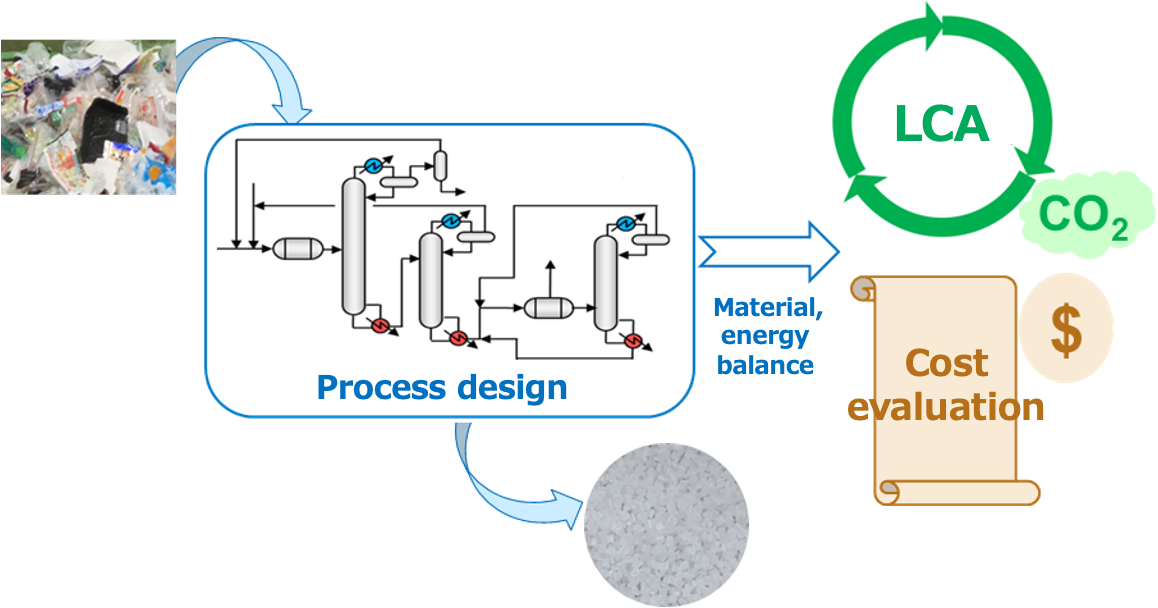
2. Development of evaluation methods for waste plastic recycling
To support the circular economy, we perform process design, cost and carbon footprint assessments, and bottleneck analyses for individual waste plastic recycling processes. We also study appropriate material selection and strategies to reduce unnecessary heterogeneous materials in order to improve recycling rates.
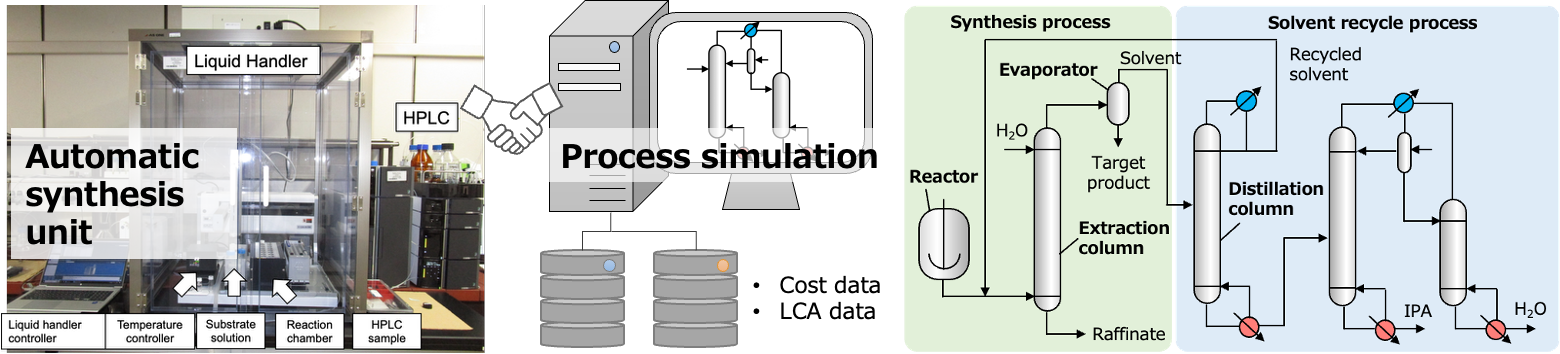
3. Development of solvent selection methods for circular processes
We are developing solvent selection methods based on conceptual process design covering stages from reaction to waste solvent recycling. This approach aims to minimize CO2 emissions and production costs across chemical production processes. By designing circulation systems for waste solvents that are currently incinerated, we contribute to advancement of circular chemical manufacturing.
- Research Groups
- Advanced Separation Materials Research Group
- Organic Resource Conversion Research Group
- Nanopore Design Research Group
- Macromolecular Functions Applying Research Group
- Continuous Synthesis Systems Engineering Research Group
- Energy-efficient Chemical Systems Research Group
- Functional Materials Processing Research Group
- Organic Reaction Chemistry Research Group
- Innovative Heterogeneous Catalytic Process Research Group
- Environmentally Benign Process Research Group