Nanopore Design Research Group
To support the realization of a sustainable circular society, we conduct research and development on the preparation of nanoporous materials with nanometer-scale pores, advanced structural characterization techniques, and applications such as sensing. We also actively promote the international standardization of nanomaterials.
Main Research Subjects
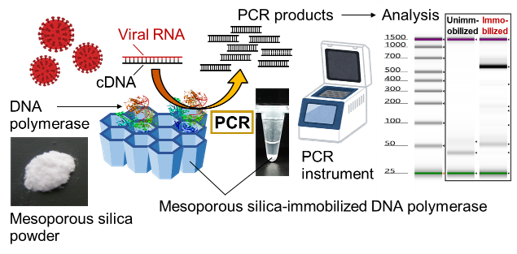
1. High-sensitivity, high-precision PCR technologies
By controlling the pore size and surface hydrophilicity/hydrophobicity of mesoporous silica based on enzyme size and surface properties, we have developed PCR technologies capable of accurately amplifying nucleic acids at the single-molecule level. By enhancing enzyme stability and durability, we successfully achieved improved resistance to reaction inhibitors and long-term storage stability at room temperature.
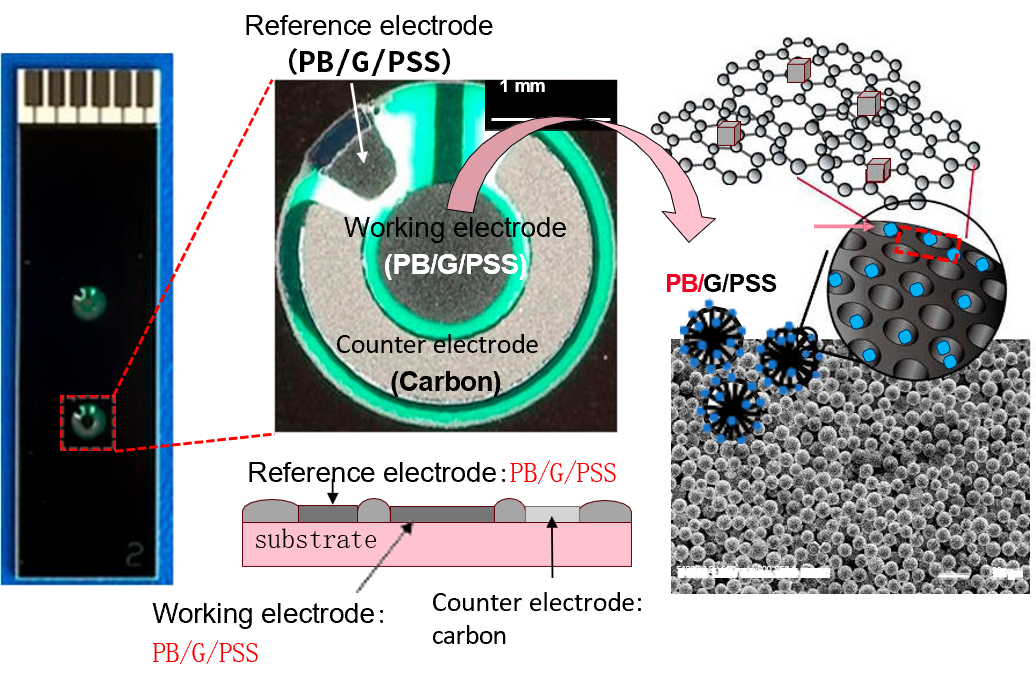
2. Sensor development using graphene-coated porous silica spheres
We are developing compact sensors based on PB/G/PSS materials. By using PB/G/PSS as a reference electrode, silver (Ag) contamination at the working electrode has been successfully suppressed, significantly extending the lifetime of compact oxygen sensors. Furthermore, when PB/G/PSS is used as a working electrode, the decomposition potentials of dissolved oxygen and vitamin C are shifted, enabling the development of precious-metal-free glucose sensors that do not require interference removal devices.
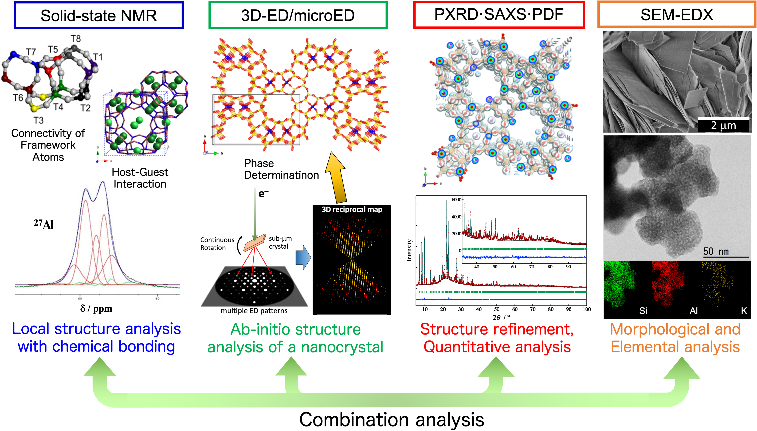
3. Multi-probe crystal structure analysis of materials with nanoscale confined spaces
We are analyzing the crystalline structures of inorganic nanoporous materials such as zeolites, which regularly include nanometer-scale pores, by a complementary combination of powder X-ray diffraction/scattering, solid-state NMR, three-dimensional electron diffraction (3D-ED), and electron microscopy techniques. This approach enables the evaluation of average and local structures, multiphase compositions, crystal morphology, and structural defects from submicron-sized crystals, supporting research on new material discovery, precise structure–property relationships, and the analysis of scarce samples.
- Research Groups
- Advanced Separation Materials Research Group
- Organic Resource Conversion Research Group
- Nanopore Design Research Group
- Macromolecular Functions Applying Research Group
- Continuous Synthesis Systems Engineering Research Group
- Energy-efficient Chemical Systems Research Group
- Functional Materials Processing Research Group
- Organic Reaction Chemistry Research Group
- Innovative Heterogeneous Catalytic Process Research Group
- Environmentally Benign Process Research Group