Advanced Separation Materials Research Group
To achieve carbon neutrality, it is essential to improve the energy efficiency of separation processes, including CO2 capture. The Advanced Separation Materials Research Group focuses on developing an integrated research platform for the fabrication of new absorbents/adsorbents/membranes and the evaluation of their resulting separation performance. Our goal is to reduce the development time for energy-efficient separation processes and to increase process efficiency by integrating these separations with reaction processes.
Main Research Subjects
1. Development of energy-efficient CO2 capture technologies using ionic liquids and amines
We have developed non-aqueous amine absorbents that significantly reduce the energy required for CO2 capture compared with conventional commercial absorbents, as well as ionic liquid-based membranes with higher CO2 permeability and selectivity than existing polymer membranes. By leveraging these advanced separation materials, we are developing energy-efficient CO2 separation processes for low-concentration CO2 streams.
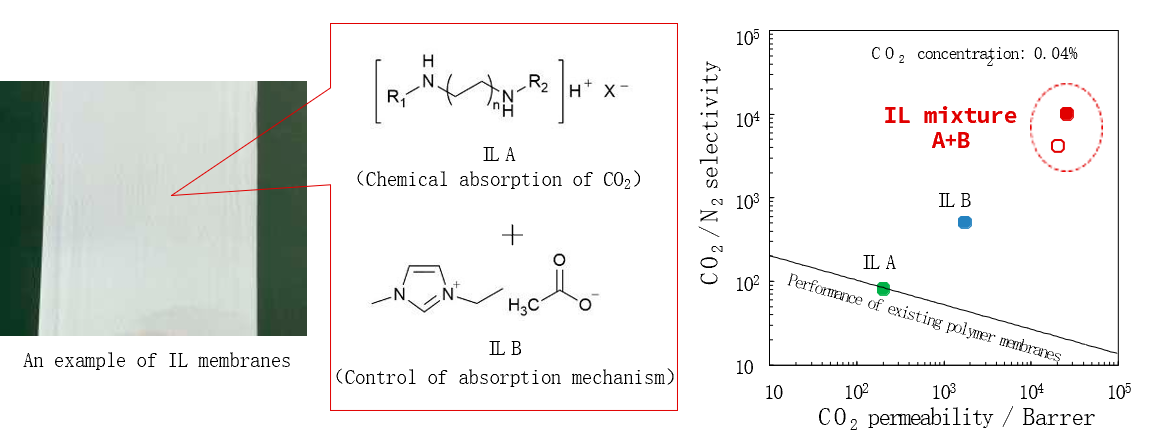
Fig. Ionic liquid (IL) membranes for low-concentration CO2 separation
2. Development of membrane-assisted reaction–separation technologies using inorganic porous membranes
Based on membrane separation process design and performance prediction technologies, we are developing membrane reactors to overcome limitations of equilibrium reactions, along with advanced membrane separation modeling techniques. For example, we have developed zeolite membranes that selectively separate water or methanol. When applied to equilibrium reactions such as transesterification, these membranes enable the removal of by-products, leading to improved reaction yields.
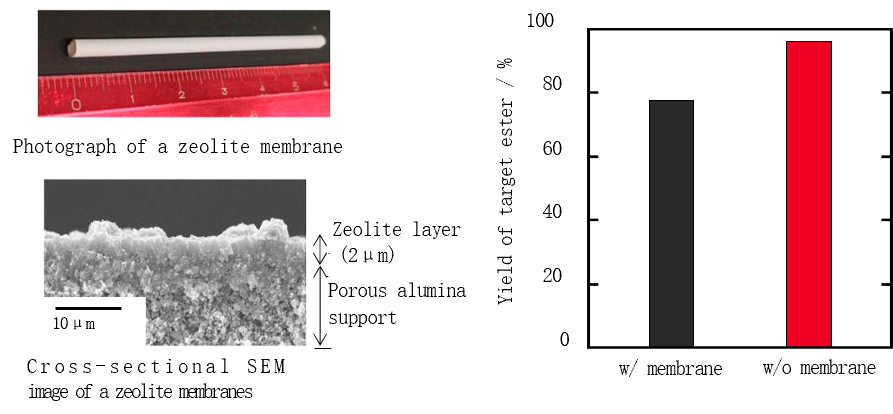
Fig. Development of zeolite membranes to facilitate equilibrium reactions
- Research Groups
- Advanced Separation Materials Research Group
- Organic Resource Conversion Research Group
- Nanopore Design Research Group
- Macromolecular Functions Applying Research Group
- Continuous Synthesis Systems Engineering Research Group
- Energy-efficient Chemical Systems Research Group
- Functional Materials Processing Research Group
- Organic Reaction Chemistry Research Group
- Innovative Heterogeneous Catalytic Process Research Group
- Environmentally Benign Process Research Group