

 Geodynamics Research Group
We conduct the research on processes and characteristics of geodynamics and related geological phenomena extend over a long period of time, such as earthquakes, faulting, volcanoes, magma intrusions, uplift, erosion and so on, to evade and/or evaluate the impact of the above geological phenomena. The results will be applied as supporting researches for Nuclear Regulation on performance assessment of natural barrier system of the geological disposal.
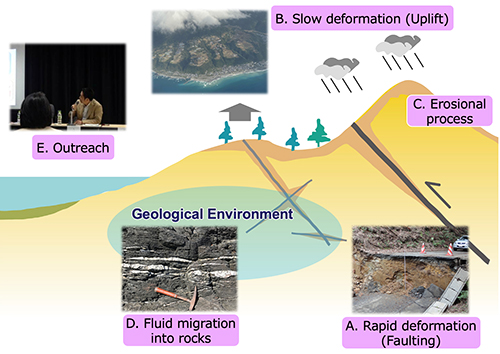
The image shows the research related to the Geodynamics Research Group. We study the effects of geological changes such as earthquakes, active faults, volcanism, magmatic activity, uplift and erosion on the subsurface environment on a time scale as long as 100,000 years.
Member
- Masanobu Shishikura ( Leader, Group) (concurrent)
- Daisuke Asahina (Senior Researcher) (concurrent)
- Kazumi Ito (Senior Researcher)
- Yuji Ishii (Senior Researcher)
- Yuta Amezawa ((Senior Researcher)
- Hinako Hosono (Researcher)
- Sumire Maeda (Researcher)
- Marceau Gresse (Researcher)
- Akane Yamamoto (Research Assistant)
- Yuki Furuno (Technical Staff)
My research focuses on paleoseismology, using evidence from landforms, geological features, and historical records. By analyzing emerged coastal landforms and uplifted biological remains, I investigate the timing of past offshore earthquakes and associated crustal movements. I also study tsunami deposits and inland active faults. Using field survey data, I work with geophysicists to model past earthquake sources.
My research focuses on rock mechanics and rock engineering. I study how rocks deform, fracture, and transmit fluids under subsurface conditions, with the goal of developing methods to evaluate long-term geological stability and to support the safe design of underground space utilization. My work is based on laboratory experiments, including true triaxial compression, permeability testing, and elastic wave measurements.
I am developing methods to evaluate ground uplift rates using luminescence dating, which enables the determination of depositional ages of sediments. By providing reliable age constraints for sediments older than 100,000 years that were previously difficult to date, this research contributes to the long-term stability assessment of the subsurface environment.
I investigate the distribution and behavior of crustal heterogeneity, particularly crustal fluids, and their relationship to seismic and volcanic activity, focusing on seismic later phases and earthquake swarms. I also develop methods for analyzing large volumes of seismogram data using machine learning and signal processing.
I conduct research on inland earthquakes and faults through seismological data analysis, laboratory experiments, and field surveys, with the aim of contributing to the understanding of earthquake generation mechanisms and the evaluation of active faults.
Geophysical imaging applied to active volcanic/geothermal areas using resistivity, self-potential, and remote sensing methods. Groundwater flow modeling of geothermal systems. My research objective is to develop new multidisciplinary approaches to better understand the subsurface structure in complex hydrogeological environnement.