

 日本語
日本語

Medical Care Technology
Research Group



Research Outline
Our goal is to realize universal access to healthcare by making medical devices smarter, easier to operate, and more automated. To achieve this goal, we conduct fundamental and applied research, foster collaboration between medicine and engineering, and actively engage in partnerships with industry.
Research Introduction
“Universal Medical Access” facilitated by Innovation of Medical Care Technology
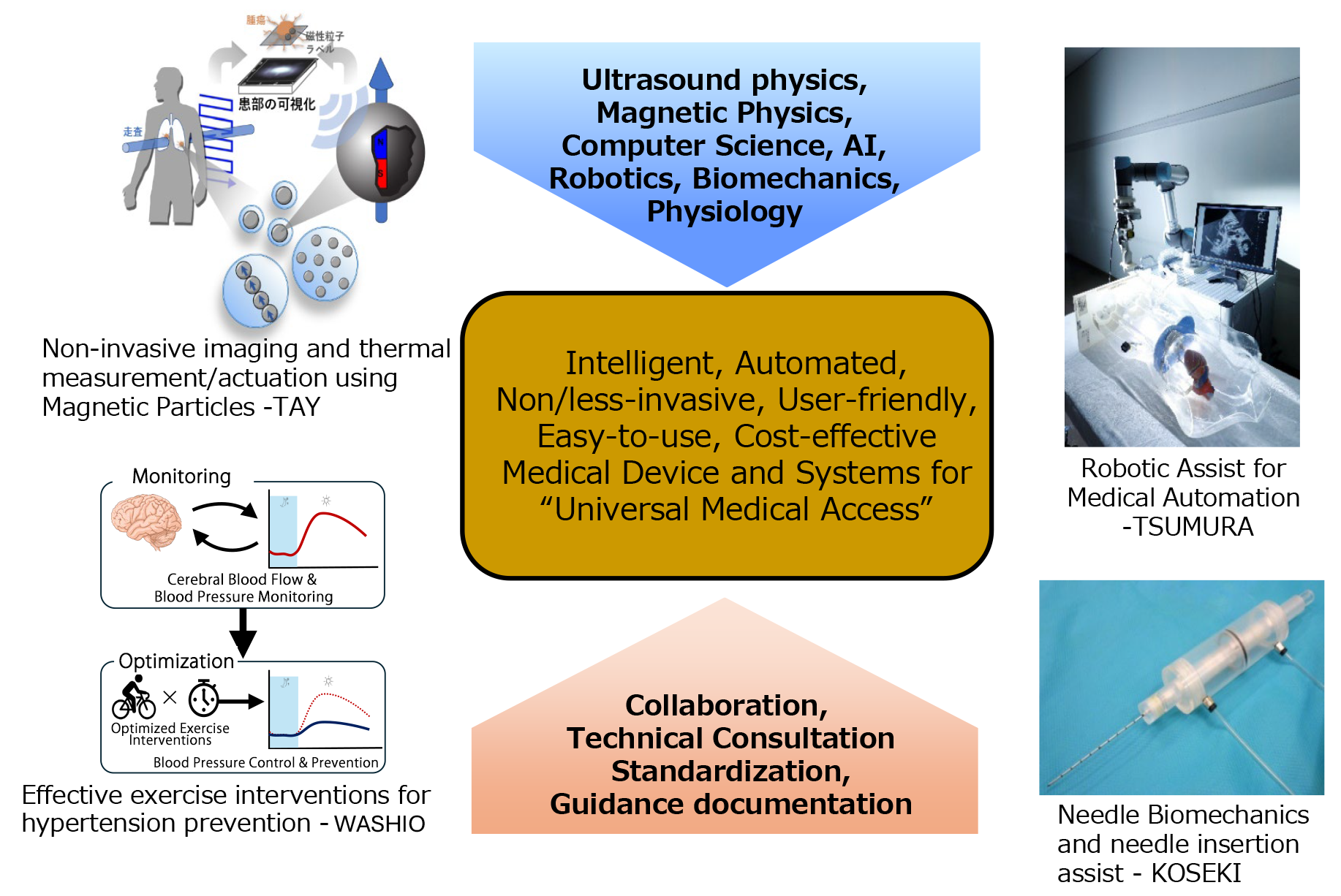
“Universal Medical Access” refers to ensuring that everyone can receive appropriate medical care anytime and anywhere, regardless of availability of medical professionals.
Our group has studied foundational and applied technologies that advance intelligent, user-friendly and cost-effective medical devices for “Universal Medical Access”. Our core technologies include noninvasive, minimally invasive, and easy-to-use modalities such as ultrasound and Magnetic Particle Imaging, intelligent systems based on AI and robotics, studies on disease mechanisms and prevention, as well as regulatory science. Through collaboration with academia, industry, government, and medical institutes, we also contribute to the rapid regulatory approval, commercialization, and social implementation of these technologies.
*This diagram can be scrolled horizontally.
Members
Primary Affiliation: Remote Self-care Technology Research Team (RSRT), Integrated Research Center for Self-Care Technology, Research Strategy Headquarters
Secondary Affiliation: Health and Medical Research Institute (HMRI)
KOSEKI Yoshihiko, M.Sc.
- Position
- Team Leader (RSRT) / Group Leader (HMRI)
- Location
- AIST Tsukuba East
- Research Profiles


- Research Theme
-
- Intraoperative measurement and minimally invasive therapy
- Measurement, control, and evaluation of needle insertion
- Safety evaluation of surgical robots
TAY Zhiwei, Ph.D.
- Position
- Senior Researcher
- Location
- AIST Tsukuba East
- Research Profiles
- Research Theme
-
- Magnetic particle imaging (MPI) technology
- Biological information measurement and magnetic hyperthermia using MPI particles
- Applications of MPI: visualization and evaluation of cell transplantation therapy
TSUMURA Ryosuke, Ph.D.
- Position
- (Primary) Industrial Technology Planning Analyst, Planning Office, Planning Division, Corporate Planning Headquarters (Attached to Research Group)
(Secondary) RSRT
- Location
- AIST Tokyo Headquarters
- Research Profiles
- Research Theme
-
- Robotic assistance technologies for diagnosis and treatment
- Automation and remote-operation technologies for diagnostic ultrasound imaging
- Automation technologies for needle insertion under CT guidance
WASHIO Takuro, Ph.D.
- Position
- Researcher
- Location
- AIST Tsukuba East
- Research Profiles
- Research Theme
-
- Elucidation of blood pressure regulation mechanisms originating from cerebral circulation and evaluation of diurnal variation
- Optimization of exercise interventions for hypertension prevention based on diurnal blood pressure variation
Research Groups
No one has solved the challenge of healthy longevity.
For those who seek that answer beyond the boundaries of discipline.
JOIN
OUR
TEAM!
