On the Publication of the “Hosoya” Local History Book
[Research Introduction & Reports List]The Hosoya District is located within Futaba Town, Futaba District, Fukushima Prefecture, and is adjacent to the Tokyo Electric Power Company’s Fukushima Daiichi Nuclear Power Plant. Following the Great East Japan Earthquake in 2011, residents evacuated immediately and have been unable to return to the Hosoya District since then.Currently, most of the area serves as an interim storage facility for contaminated soil and waste generated by decontamination efforts within Fukushima Prefecture. Many homes have been demolished, and temporary incinerators and waste storage facilities have been established, resulting in a landscape vastly different from that of before 2011.
Around 2019, members of our research group spoke with Mr. Ohashi, the former district chief of the Hosoya District. During that conversation, he expressed his hope that “even if we may never be able to return to this land, we want to preserve the memories of this area and its people.” Inspired by this, we began the project to create a local history book. Through repeated conversations with local residents and by walking the area, we created a “memory map” based on people’s recollections and photographs of the region, as well as a local history book.We presented the completed local history book to Ward Chief Tanaka, former Ward Chief Ohashi, and the residents of the Hosoya District at the Hosoya District General Meeting on June 22.We also donated copies to Futaba Town and the Fukushima Prefectural Library, among others. Subsequently, following media coverage, we began receiving requests from people who wanted to read the district history book. Against this backdrop, after consulting with District Chief Tanaka and former District Chief Ohashi, we decided to publish the book on our website in January 2024, as this would also serve as an opportunity for many people to learn about the Hosoya District of Futaba Town.
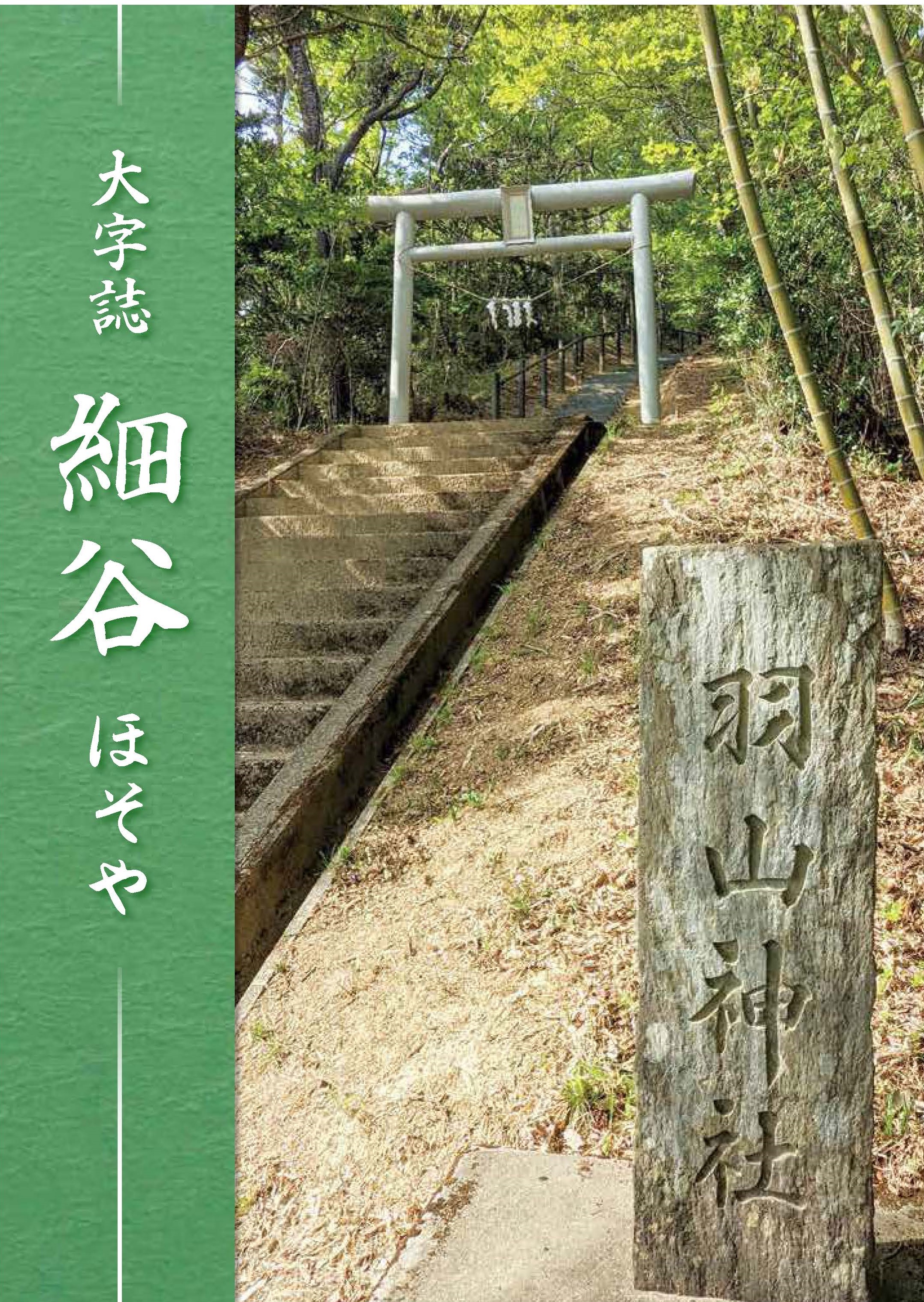
Download PDF Version [PDF: 4.8 KB]
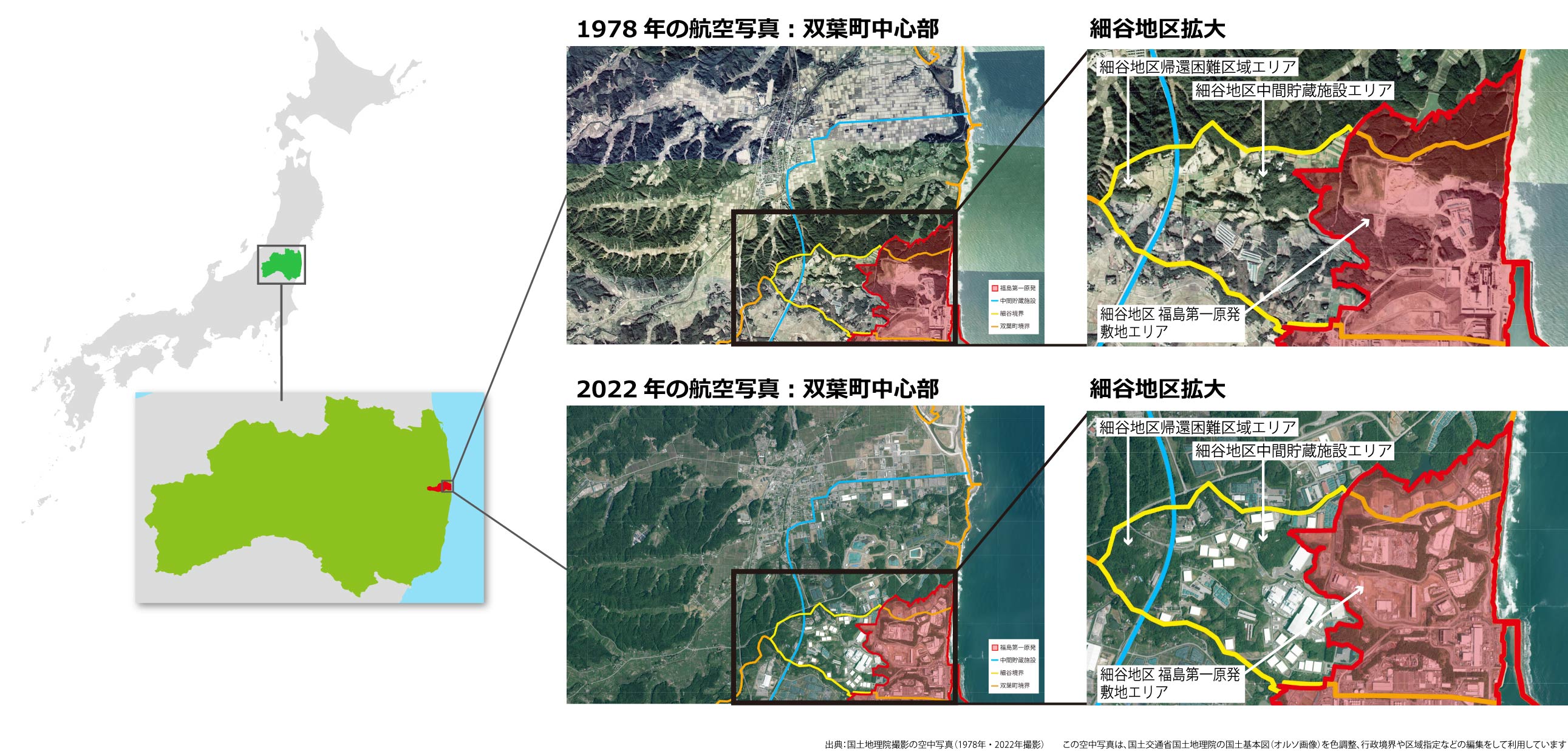
Location of the Hosoya District and Past and Present Aerial Photographs
[Open Enlarged Version]
Conveying Our Feelings for Our Hometown
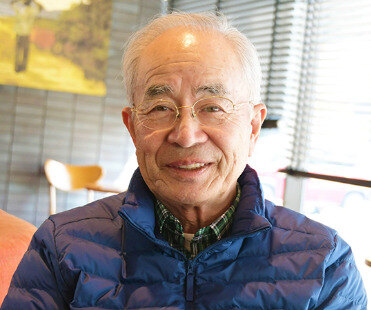
Yoichi Ohashi, Former Head of the Hosoya Administrative District, Futaba Town
 My hometown, Futaba Town, was
rich in greenery and blessed with seasonal bounties such as wild mountain vegetables, offering a peaceful and
pleasant living environment.
The Hosoya Administrative District, where I lived, had about 45 households and a population of around 160
people. It was common for three generations to live together, and there were even households with four
generations under one roof; everyone in the district knew one another.
The Tokyo Electric Power Company’s Fukushima Daiichi Nuclear Power Plant was located adjacent to the district,
and in 2011, the closest house was about 30 meters from the fence. At 2:46 p.m. on March 11, 2011, a magnitude 7
earthquake struck, followed by a tsunami. As head of the Hosoya Administrative District, I patrolled the area,
and fortunately, there were no casualties.
My hometown, Futaba Town, was
rich in greenery and blessed with seasonal bounties such as wild mountain vegetables, offering a peaceful and
pleasant living environment.
The Hosoya Administrative District, where I lived, had about 45 households and a population of around 160
people. It was common for three generations to live together, and there were even households with four
generations under one roof; everyone in the district knew one another.
The Tokyo Electric Power Company’s Fukushima Daiichi Nuclear Power Plant was located adjacent to the district,
and in 2011, the closest house was about 30 meters from the fence. At 2:46 p.m. on March 11, 2011, a magnitude 7
earthquake struck, followed by a tsunami. As head of the Hosoya Administrative District, I patrolled the area,
and fortunately, there were no casualties.
However, several houses collapsed, the majority of homes
sustained some form of damage, and cracks ran through the roads, making it extremely difficult to drive.
Then, around 5:30 p.m., a disaster prevention radio announcement stating, “Evacuate immediately to a location
more than 3 kilometers from the nuclear power plant,” was broadcast, and we evacuated to the town’s community
center.
The following day, the evacuation order zone was expanded to include areas within a 10-kilometer, 20-kilometer,
and 30-kilometer radius. Believing they would be able to return the next day,
most residents of Hosoya evacuated with only the clothes on their backs, but they never returned to their
familiar lives, and the local community as it once was was lost.
In January 2015, Futaba Town agreed to host the construction of an interim storage facility, and most of the
Hosoya district became part of the construction site. Every time I visited, the landscape of my hometown had
changed so drastically that it took my breath away.
Living in a relatively peaceful evacuation site, I find myself thinking day after day, “I want to return to my
hometown, even if only in my heart.”
At the same time, feeling a sense of responsibility to restore the kind of communication we once had and pass on
the memories of Hosoya to the next generation, I found the compilation of Hosoya’s history to be both a joy and
an invaluable endeavor.
I want to see the further reconstruction of Futaba Town with my own eyes; I hope it will become a reborn Futaba
Town that appeals to the next generation and people from outside the town, leading to expanded interaction…
Although my hometown is lost and I cannot return, I have devoted myself to doing what I can for the future,
even after being evacuated. We had planned to rebuild the main hall of Hayama Shrine before the disaster, but it
collapsed due to deterioration and the earthquake. With the understanding of the town office and the Ministry of
the Environment, we were able to rebuild it, and we hold our annual grand festival there every spring.
Furthermore, in 2017—after the evacuation order was lifted—we transplanted the red spider lily bulbs that had
been planted along a town road in the Hosoya district before the disaster and began blooming beautifully after
our evacuation to the Yamakiya district of Kawamata Town, with which we had formed a special connection.
Every autumn, members of the Hosoya, Futaba Town, and Yamakiya Support Group gather for the “Red Spider Lily
Appreciation Gathering,” expanding our circle of friendship.
We aim to one day transplant some of these red spider lilies back to Futaba Town as a sort of “homecoming.”
Together with members of the National Institute of Advanced Industrial Science and Technology (AIST) and Kobe
University—whom we met through the red spider lily transplant project and our annual gatherings—we decided to
create this community chronicle to preserve it for future generations. We will pass this publication, born from
the connections of so many people, on to our descendants and entrust it with our hopes for Futaba Town’s future.
The long-term evacuation caused by the nuclear accident was an utterly unjust experience, but just as with my
own life, I cannot help but hope that our town will also achieve recovery through the connections between many
people.
Toward the Preservation of Memory
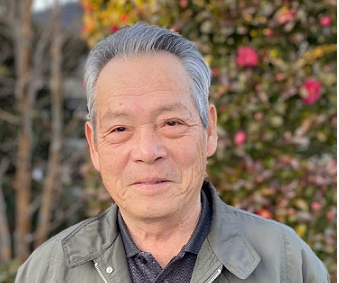
Shinichi Tanaka, Head of the Hosoya Administrative District, Futaba Town
 It has already been nearly 12
years since the Great East Japan Earthquake on March 11, 2011, and the nuclear accident—said by some to be the
world’s worst—triggered our life in evacuation. Since then, we have found ourselves in a situation where we can
never return to our homes.
It has already been nearly 12
years since the Great East Japan Earthquake on March 11, 2011, and the nuclear accident—said by some to be the
world’s worst—triggered our life in evacuation. Since then, we have found ourselves in a situation where we can
never return to our homes.
Before the disaster, we lived in a cherished home with a family of ten spanning four generations—a house full
of memories that I had worked hard to build in my own way. I spent a long time preparing the lumber myself and
commissioned a local contractor to build it.There was a stone pagoda in the garden, koi swam in the pond, and on
the day of their coming-of-age ceremony, my daughters posed for photos there. When I returned home temporarily,
I found that even the interior of that house full of memories had been ransacked by wild animals; it was in such
a pitiful state that I felt truly heartbroken and on the verge of breaking down.After that, most of the Oaza
Hosoya district became the site for the interim storage facility, and since my house was located within that
area, the main house was demolished. The pain of coming to terms with that was so profound it’s hard to put into
words. Having gone through all these experiences, I now feel that rather than dwelling on the past, I want to
face reality head-on and live peacefully, looking forward to watching my grandchildren grow up.
Until the nuclear power plant accident, the Hosoya district was a village rich in greenery and teeming with
nature. However, every time I returned home temporarily, I witnessed my hometown changing beyond recognition due
to the construction of the interim storage facility. It is deeply regrettable to see the way of life and culture
that many of our forebears built up over generations being forgotten.Had we continued to live in Hosoya, that
way of life would have been naturally passed down to our grandchildren. Now that this is no longer possible, if
we do not record it somehow, the Hosoya district will cease to exist. It was at that time that I was approached
by members of the National Institute of Advanced Industrial Science and Technology (AIST) and Kobe
University—whom I had met at the “Higanbana Appreciation Society” event in the Yamakiya district—and they
suggested we collaborate to create a local history book. That was the primary reason I undertook this
project.
Another reason was that I agreed with the idea of contributing to the town-building efforts of Futaba Town.
While our generation may not be directly involved in the future use of the site of the interim storage facility,
I hope that by conveying what life was truly like there—a way of life adapted to that land and climate—we can
help support the town’s future development.
I reached out to the officials of the Hosoya Administrative District and gathered as many stories as possible,
but there may still be some important stories that were not included, or parts that are not entirely accurate in
terms of figures. However, I believe this publication has succeeded in conveying, even if only a little, the
history, culture, and way of life of the land that was once part of the interim storage facility site. It is
deeply meaningful to me to have been able to preserve a record of my hometown, the Hosoya District, in this way,
and I would be delighted if this legacy could be passed on to future generations.
In closing, I would like to express my heartfelt gratitude to the many people who cooperated in the early
recovery of Futaba Town and in the creation of this district history.
Editor’s Note
Editor-in-Chief: Tetsuo Yasutaka, AIST
The creation of this village chronicle began when the editor met Mr. Ohashi, Mr. Tanaka, and others in
the Hosoya district through a connection involving the red spider lily.
Rather than just hearing stories, I visited the area and witnessed the changes in Hosoya following the
earthquake. This led me to believe that the many people who will visit this area in the future need to
understand the region’s history.
With the support of Mr. Tanaka and Mr. Ohashi, I was able to hear stories from many people.
We also had the opportunity to participate in local cultural events, such as the annual festival at Hayama
Shrine and the making of kashiwa mochi.
First and foremost, I would like to express my sincere gratitude to everyone involved.
>This community history was compiled primarily based on the memories shared by Hosoya residents.
Memories are subjective, and especially when they pertain to the distant past, they cannot always be
considered accurate.
There is also a bias in the ages and genders of those who cooperated with us.
However, rather than focusing on objectively correct facts, this community history aims to convey the daily
life and scenery of the region through heartfelt, personal stories.
To make the content easier to understand, we have first included “Basic Information” that provides the
context for these memories, followed by “Memories of Hosoya.”
We hope this will serve as a starting point for the reminiscences of Hosoya residents and as a reference for
those involved in the reconstruction of Futaba Town and future regional development.
The interviews, editing, printing, and binding related to this community history were carried out using
funding from the E-code budget of the Interdisciplinary Research Laboratory at the National Institute of
Advanced Industrial Science and Technology (AIST) and
the Comprehensive Environmental Promotion Fund (JPMEERF22S20930) of the Japan Environment Restoration and
Conservation Agency (JERCA). We also received cooperation from the Futaba Town Office and the Ministry of
the Environment. We would like to express our sincere gratitude to them.

June 22: Donation of the Local History Book
(From left: District Chief Tanaka, Former District Chief Ohashi, Research Group Leader Yasutaka)
- Editor-in-Chief:
- Tetsuo Yasutaka (National Institute of Advanced Industrial Science and Technology)
- Editor:
-
Yoichi Ohashi (Hosoya Administrative District, Futaba Town)
Shinichi Tanaka (Hosoya Administrative District, Futaba Town)
Tetsuo Yasutaka (National Institute of Advanced Industrial Science and Technology)
Yumiko Kanai (National Institute of Advanced Industrial Science and Technology)
Yoriko Igarashi (National Institute of Advanced Industrial Science and Technology)
- Interviewer:
-
Tetsuo Yasutaka (National Institute of Advanced Industrial Science and Technology)
Sakurako Sakahara (Formerly of Kobe University / Formerly of the National Institute of Advanced Industrial Science and Technology)
Momo Takada (National Institute of Advanced Industrial Science and Technology)
Yumiko Kanai (National Institute of Advanced Industrial Science and Technology)
- Illustration:
- Yoriko Igarashi (National Institute of Advanced Industrial Science and Technology)
- With the cooperation of:
- Shinko Fujii (National Institute of Advanced Industrial Science and Technology)