Research Groups & Labs
We have 6 research groups and 1 research labs.
| Research Groups | Labs |
Engine Systems Research Group
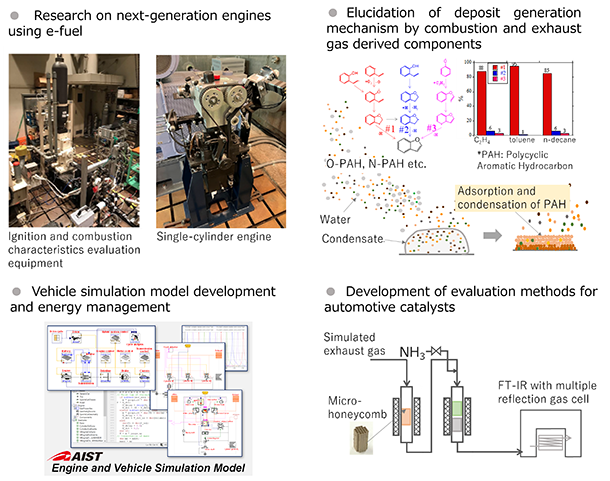
We are conducting research that contributes to the development of zero-emission mobility technologies for vehicles in order to achieve carbon neutrality by 2050. Specifically, we are engaged in basic and pioneering research on fuel, spray, combustion, and emission purification technologies for the development of highly efficient engine systems, as well as the development of vehicle simulation models and energy management research includes power source electrification.
Keywords : Internal combustion engine, e-fuel, Spray, Combustion, Catalyst, Vehicle
simulation model, Energy management
 |
Thermofluid System Research Group
Our main mission is to construct a technical foundation for the approaching of the “sustainable society”. Our research topics include microfabrication, numerical simulation, and visualization technologies related to electronic device cooling, heat-pumps, and power generation cycles. In addition, our research covers the electrochemical energy conversion devices such as fuel cells, water electrolyzers, and co-electrolyzers.
Keywords : Water electrolysis, Solid oxide cell, Boiling cooling, Heat exchangers, Heat pipe (Vapor chamber), Heat and flow visualization, CFD (Computational fluid dynamics)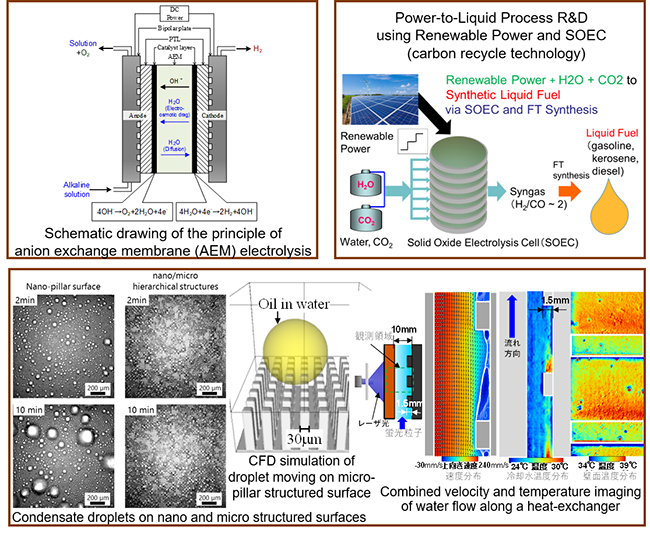 |
Materials Physics Research Group
As a sustainable low-carbon society, it is strongly desired to develop
technologies for efficient use of energy and for reducing carbon dioxide
emissions. In order to respond the need of society, Materials Physics Group
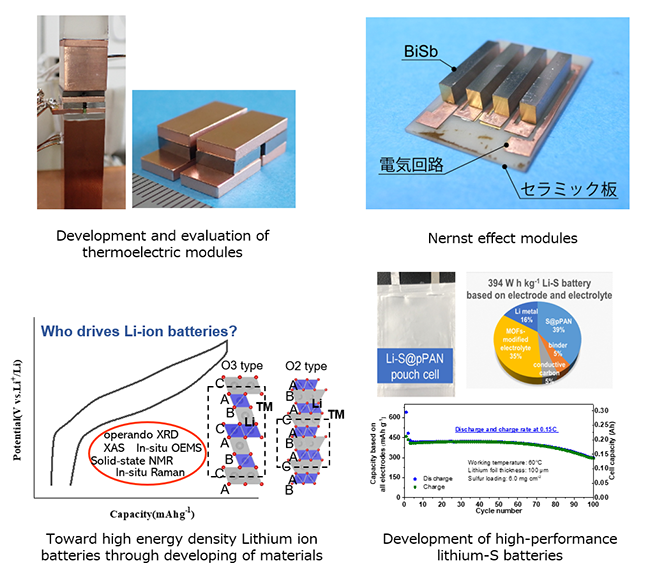
investigates physicochemical phenomena of thermoelectric materials, developing
new materials, and development and evaluation of thermoelectric modules.
Furthermore, our group develops the post lithium-ion batteries with high
capacity and power, which is considered a promising next-generation storage
system.
Keywords : Thermoelectric materials, Thermoelectric power generation, Thermoelectric
modules, Perovskite solar cells, Electrode materials, Lithium-S battery
 |
Energy Conversion Device Research Group
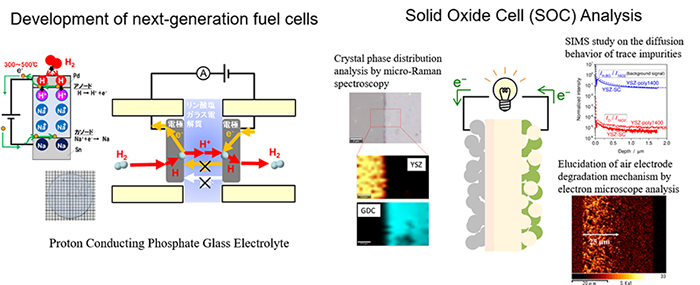
Research and development of highly efficient energy conversion technology is indispensable in meeting the increasing demands for electrification of energy. Our group is focusing on research and development of energy conservation devices operated at high temperatures – solid oxide fuel cells (SOFC) for converting with high efficiencies diverse types of fuels such as fossil and biomass fuels into electric power, and solid oxide electrolysis cells (SOEC) for converting surplus power from renewable energies into highly efficient and high-value added fuels. In particular, we play an important role as a public research institute in the ongoing efforts for the enhancement of SOFC durability/reliability through collaboration with companies and universities. As a future endeavor, even more highly efficient electrochemical energy conversion devices based on solid state ionics phenomena are envisaged by carrying out comprehensive research and development with advanced evaluation techniques including synchrotron radiation X-ray spectroscopy, and thus further contribute to the realization of a low carbon society.
Keywords : Energy Conversion Devices, Solid Oxide Fuel Cell (SOFC), Solid Oxide Electrolysis Cell (SOEC), Solid State Ionics, Synchrotron Radiation X-ray Spectroscopy
 |
Energy Storage System Research Group
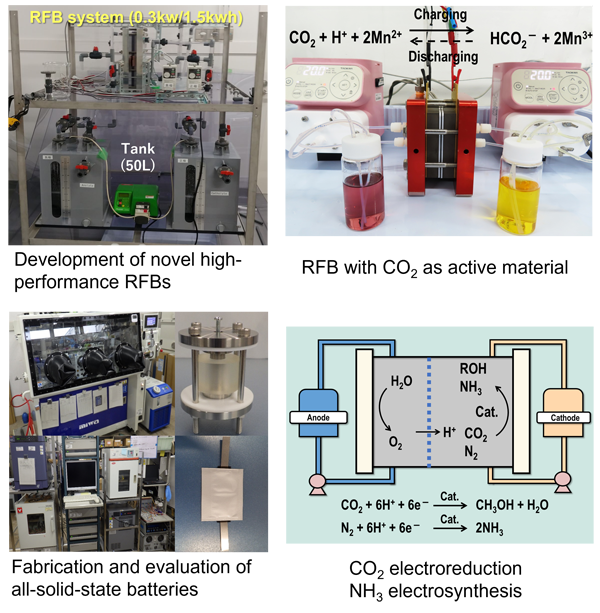
Our group aims to develop highly efficient energy storage technologies that contribute to the reduction of greenhouse gases and the effective use of energy resources. Specifically, we are engaged in research on various elemental technologies (material and cell development, evaluation of stability and performance, and development of reaction system) that make up energy storage systems, including in addition of redox flow batteries (RFBs), lithium ion batteries (LiBs), and all-solid-state batteries, the development of new storage technologies using hydrogen and CO2 or N2 based on chemical/electrochemical reactions.
Keywords : Redox Flow Batteries, Lithium-ion Batteries, All-Solid-State Batteries,
CO2 electroreduction, NH3 electrosynthesis
 |
Energy Crystal Research Group
Lithium secondary battery is expected as devices for future low carbon
society by widely use and development for large power supplies of automobiles,
stationary, IoT etc. Therefore, it is important to be safety, long life,
higher capacity, and low cost.
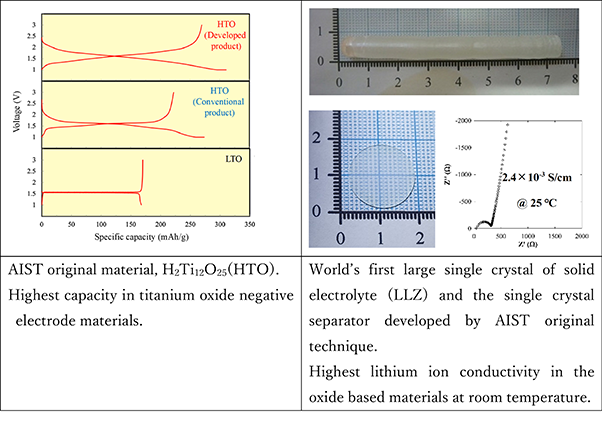
In our group, advanced oxide based materials, such as new electrode materials
and solid electrolyte materials, have been developed for next generation
liquid type lithium secondary battery and all solid lithium secondary battery.
In addition, advanced material design has been promoted by development
of new synthesis processes, and application of techniques such as crystal
structure analysis and physical properties evaluation.
 |
Collaborative Engine Research Laboratory for Next Generation Vehicle
In regard to the interdisciplinary research subjects related to the automotive engines, our collaborative research team contributes to reinforce the competitiveness of the automotive industry in Japan by consolidating the potentials of AIST researchers from diverse research fields under the flag of ‘All-AIST Cooperation’. The research subjects of our team are not confined to the engine combustion and after-treatment technologies, but include more diverse research subjects such as automotive control, system analysis and evaluation and automotive materials. Our upcoming mission is to accelerate the development of clean and efficient next-generation engines by intimate collaboration with Japanese automotive manufacturers.
Keywords : Internal combustion engine, Automotive fuel, Fuel spray, Engine combustion, Emission catalyst, standardization, System, Control
Task Map of Automotive Engine Research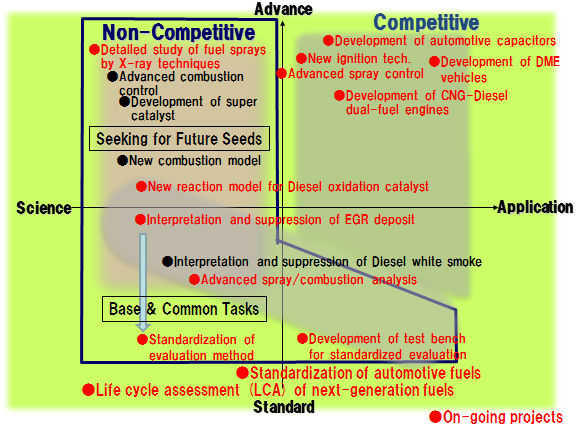 |