Research Overview and Reports
[List of Research Highlights and Reports]
4] Research on Interaction Activities Between Residents and Outsiders in Yamakiya
Published in: Transactions of the Society for Rural Planning, Vol. 2, No. 1, 2022
Paper Introduction Authors: Sakurako Sakahara and Tetsuo Yasutaka, Geosphere Chemistry Research Group
A paper on exchange activities between residents and outsiders in Yamakiya was published in the Journal of the Japanese Society of Rural Planning.
Title
The Significance and Effects of Community Exchange Activities Incorporating Radiation Education in Former
Evacuation Zones Following a Nuclear Disaster
—Focusing on Community Exchange Activities in the Yamakiya District, Kawamata Town, Fukushima
Prefecture—
(Significance and Impact of Community Empowerment Including Learning Radiology in a District
Formerly Evacuated for Nuclear Disaster
: A Case Study of the Yamakiya District, Kawamata Town, Fukushima Prefecture)
Authors
Sakurako Sakahara a b, Uki Nagano a, Tetsuo Yasutaka b, Yumiko Kanai b, Momo Takada b
- Graduate School of Agriculture, Kobe University
- National Institute of Advanced Industrial Science and Technology (AIST)
Abstract
In the reconstruction process of districts that underwent long-term evacuation following the nuclear
accident, “interaction with the outside world” is considered important for fostering new human connections.
At the same time, when considering the continuation and expansion of these exchange activities, it is also
important to address the significance of participation for external participants and to address their
concerns about radiation, which are perceived as barriers to participation.
To clarify the perceived significance of participation and attitudes toward radiation among participants
from outside the region, the authors conducted a questionnaire survey targeting these participants, using
the “Yamakiya School”—a community exchange program that has been ongoing since 2016 in the Yamakiya district
of Kawamata Town, Fukushima Prefecture (Figure 1)—as a case study.
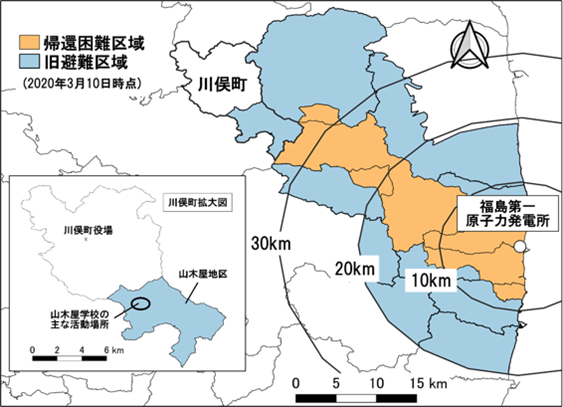
Figure 1: Location of the Yamakiya District, Kawamata Town
Significance and Effects of Participation for External Participants
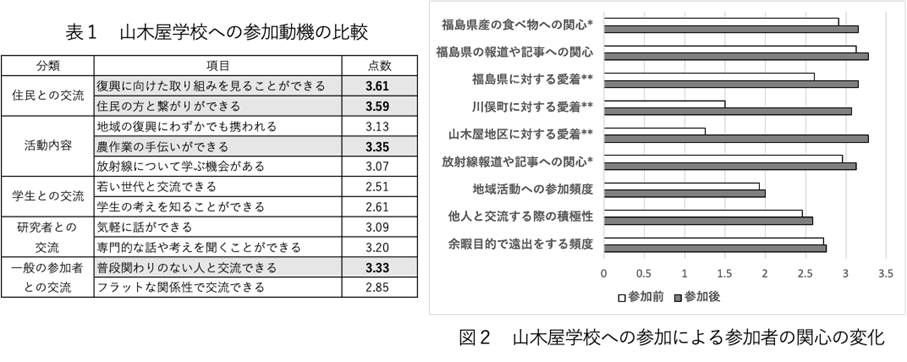
The main reasons participants continued to participate were that they enjoyed the activities offered by the
Yamakiya School—such as hands-on farming experiences—and their interactions with residents, as well as a
desire to witness the residents’ recovery process firsthand (Table 1). Furthermore, while participation in
these exchange activities was found to deepen participants’ understanding of and attachment to the
community, no significant changes were observed in their daily lives (Figure 2).It became clear that, for
participants, the significance of participating in these activities lay in experiencing a sense of the
extraordinary—such as immersing themselves in farm work in a natural setting unlike their daily lives and
interacting with people they could only meet in Yamakiya.
Awareness of Radiation Among External Participants
At Yamakiya School, activities such as radiation education sessions led by the organizing researchers and hands-on experiences measuring radiation levels in wild vegetables were actively conducted at the start of the program (around 2016–2017). However, it became clear that these activities did not influence changes in participants’ anxiety levels regarding radiation at that time. The main reason for this was that many participants already possessed basic knowledge about radiation and had decided to participate after assessing the safety of the activities (Figure 3).On the other hand, it is believed that these activities—which provided radiation knowledge and measurement experience—served to reinforce the participants’ existing understanding.
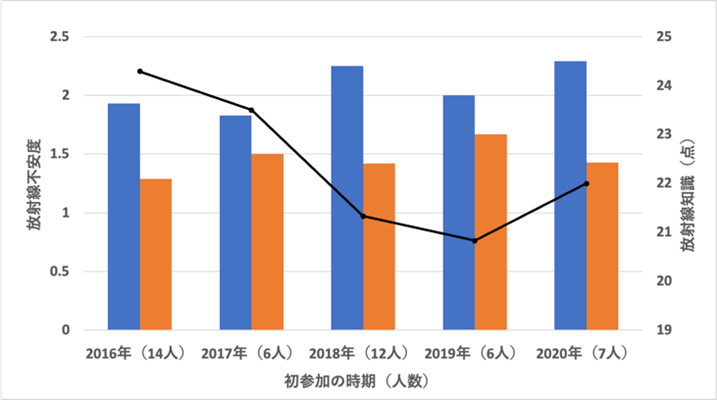
Figure 3: Relationship between the timing of first participation at Yamakiya School, radiation anxiety levels, and radiation knowledge
The authors hope to continue deepening their understanding of the current situation in the region and to contribute to the reconstruction of the disaster-affected areas and the improvement of residents’ living environments.
[Acknowledgments]
We would like to express our sincere gratitude to the residents of the Yamakiya district in Kawamata Town for their cooperation in conducting this study, as well as to everyone who participated in the interviews and questionnaire surveys. This research was supported by a Grant-in-Aid for Scientific Research (JSPS KAKENHI) Grant No. 18H04141.
[Original Publication]