Promotion of DNA Base-Pair Formation by Sub-Terahertz Irradiation
Biomolecular functions emerge from selective changes in the transition probabilities of molecular motions driven by thermal fluctuations. Among the various factors involved, interactions between biomolecules and surrounding water molecules, particularly the dynamic properties of hydration water, are considered to play critical roles. However, the detailed mechanisms remain insufficiently understood.
In this study, we irradiated aqueous DNA solutions with sub-terahertz (sub-THz, 0.1–0.3 THz) electromagnetic waves to strongly perturb the motions of DNA hydration water that can respond to the oscillating field. The resulting responses were monitored using ultraviolet absorption spectroscopy and fluorescence correlation spectroscopy.
At these frequencies, hydration water molecules whose hydrogen-bond constraints are relatively weakened by the electric fields of DNA phosphate groups and counterions can follow the oscillating external field through rotational motion In contrast, the collective rotational motions of bulk water strongly coupled through hydrogen bonds and hydration water tightly bound to DNA, as well as the overall rotational motion of DNA molecules, cannot sufficiently follow the oscillating field. Consequently, the direct influence of the external field is expected to act selectively on specific hydration water molecules located near the DNA surface.
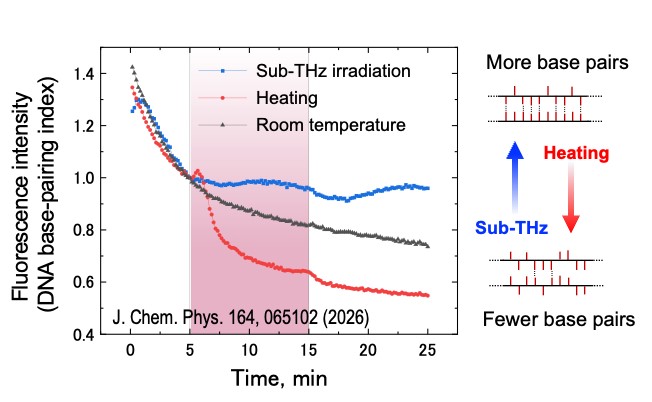
We employed random-sequence oligo DNA possessing diverse structural ensembles Immediately after rehydration, these molecules predominantly form disordered π–π stacked structures. During equilibration, they gradually transition into more ordered structures accompanied by complementary base-pair formation. This structural transition does not proceed markedly under simple temperature elevation (uniform enhancement of thermal fluctuations). However, when the rotational motion of hydration water is selectively modulated by sub-THz irradiation, the transition is significantly accelerated.
Sub-THz irradiation can induce slight temperature increases in the aqueous DNA solution, and it is therefore necessary to distinguish such thermal effects. However, this structural transition does not proceed markedly under simple temperature elevation, that is, a uniform enhancement of thermal fluctuations. In contrast, when the dynamics of the specific hydration water is selectively modulated by sub-THz irradiation, the transition is significantly accelerated.
These findings suggest that superimposing field-induced rotational (orientational) motion of water molecules onto intrinsic thermal molecular motion can slightly modify the statistical properties of thermal fluctuations, thereby altering the transition probability toward specific structural states.
Research group
AIST
- Masahiko Imashimizu (Cellular and Molecular Biotechnology Research Institute, AIST)
- Johtaro Yamamoto (Health and Medical Research Institute, AIST)
Other institutions
- Yuji Tokunaga & Koh Takeuchi Takeuchi (Graduate School of Pharmaceutical Sciences, Univ Tokyo)
The figure shows experimental results measuring changes in fluorescence intensity in a pool of random DNA sequences (mostly single-stranded) when exposed to either 0.1 THz irradiation or conductive heating for 5–15 minutes (indicated by the red shaded region). Fluorescence intensity reflects the amount of base pairing (double-stranded DNA) because the fluorescent dye emits strongly when bound to double-stranded structures. An increase in fluorescence indicates an increase in DNA molecules containing base pairs, whereas a decrease indicates base-pair dissociation. Compared with the room-temperature control, 0.1 THz irradiation led to an increase in fluorescence intensity, indicating promotion of base-pair formation. In contrast, conductive heating caused a decrease in fluorescence intensity, promoting strand dissociation. Thus, irradiation and heating produced opposite effects.
Publication
- Title:Non-thermal acceleration of DNA base pairing by sub-terahertz irradiation
-
Authors:Johtaro Yamamoto, Yuji Tokunaga, Koh Takeuchi, Masahiko Imashimizu*
*Corresponding author - Journal:The Journal of Chemical Physics, 164, 065102 (2026)