1. INTRODUCTION
The ecological risk assessment methodology involves two main disciplines: ecology and applied risk assessment theory. In the field of ecology, many studies have been conducted on how species become extinct and how populations change based on analytical techniques.
On the contrary, in the field of applied risk assessment theory, one core concept is relevance to the protection of human health and in this sense, ecological systems are simply assumed to be food production systems. Data and methodologies available for ecological risk assessment are limited, so we have been developing methodologies such as how to integrate the incomplete data. As this is only the start, much work remains before risk assessment can be used to solve real-world problems.
Our team has ten members who are experts in ecological risk assessment, led by Dr. Akihiro Tokai. Our mission is to develop methodologies for ecological risk assessment for chemical risk management, with special focus on the scope of population dynamics in the real world. The scope of our work is described conceptually by eq. (1). In this equation, to perform risk assessment, we need to define the source receptor relationships throughout the life stages of chemicals.

…eq
where,
: the exposed population
: the amount of chemicals consumed per capita
: the quantity of chemicals emitted per unit consumption
: ambient concentration of chemicals derived from the quantity of chemicals emitted
: exposure dose of chemicals through environmental exposure
: exposure of the target organ to chemicals, derived from the dose
: the risk derived from the effective dose
2. Research Topics
A. Methodology of risk assessment
1) Development and practical application of ecological risk modeling method within the scope of population dynamics
2) Quantification of ecological risk based on species sensitivity distribution analysis
3) Development and practical application of CASM modeling with indication of biomass
4) Development and quantification of uncertainty of risk assessment model
B. Practical application of exposure methodology
5) Ecological dynamics model for Tokyo Bay area through distributed modeling approach
6) Basin-wide ecological model for watershed area
7) Integrated modeling ecological process and economic process
C. Generalization of risk assessment case analysis
8) Pattern classification of chemicals and exposure
9) Pattern classification of risk level and alternatives
2.1 Methodology of Risk Assessment
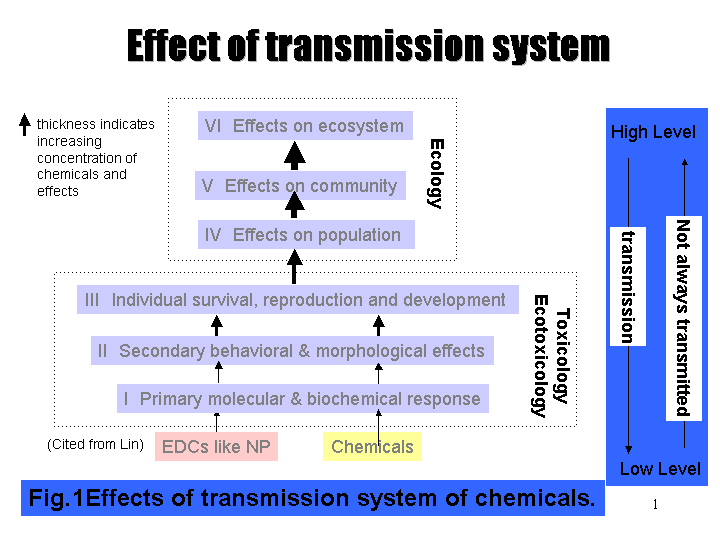
Figure 1 shows the propagation ladder of effects when biota are exposed to chemicals. Traditionally, ecological response has been expressed as the acute effect for an individual level of biota. We are developing a methodology based on population dynamics which includes the manner in which chemicals propagate in biological and ecological systems.
We have proposed a methodology based on the population growth rate as an index using a population dynamics model (Lin, 2003). As a more comprehensive approach, we have also developed and applied the CASM modeling approach as shown in Figure 2 for ecological risk assessment in terms of the change in the amount of biomass (Miyamoto, 2000).
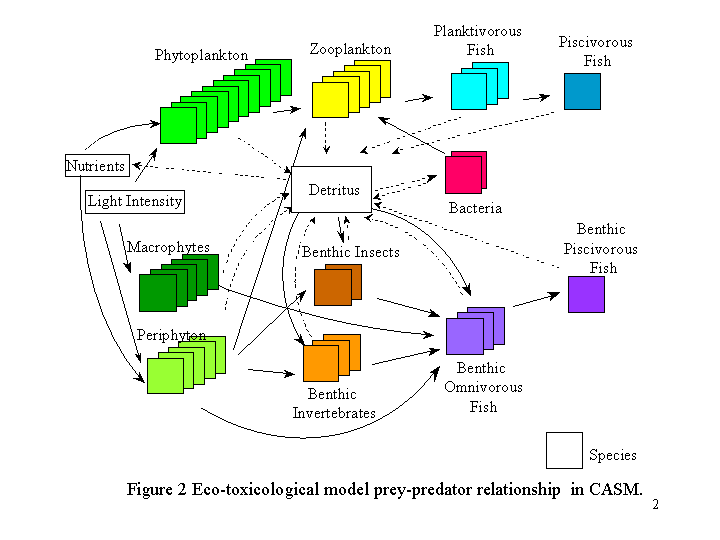
In estimating the impact, the relationship between prey and predator is explicitly modeled. In the next step, we need to explore the applicability of this kind of model by introducing a parameter estimation method such as the life history of each species.
2.2 Practical Application of Exposure Methodology
We have developed a three-dimensional model of the quality of water in Tokyo bay, taking into account ecological processes. We have already applied this model to tributyl tin and shown the good spatial resolution of exposure analysis.
In parallel with this, we have been developing a basin-wide ecological model which explains the mechanism of emission amounts of chemicals and inland water quality based on the distributed modeling approach. We have applied this model to the case of nonylphenol and chlorinated paraffin. In the near future, these models will be integrated for performing more realistic risk assessments.
2.3 Generalization of Risk Assessment Case Analysis
In real-world problems, effort is sometimes needed to gather good-quality hazard or exposure data that can be used for risk assessment. Model estimation might help fill in the gaps in the data and we are developing a modeling methodology that uses important data such as expert judgment.
Expert opinions and judgments are a good means of improving the modeling applicability or parameter estimation. By utilizing these kinds of information, we are trying to classify the chemical risk assessment results based on this kind of analysis for generalizing the assessment results.
3. Summary
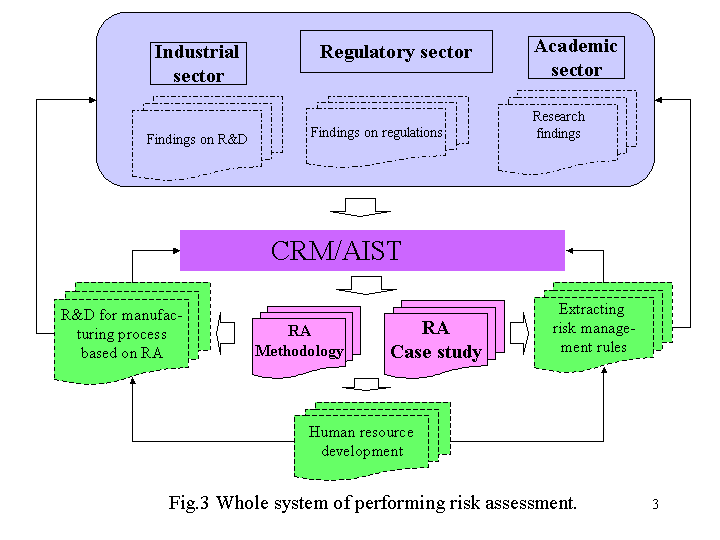
Finally, what is the scope of the risk problems? In performing risk assessments, we first learn from preceding works in order to define the problem. Sometimes, risk related problems are called ill-structured problems, because many items must be organized. First, we must organize the problem space which we refer to as risk. Figure 3 shows the overall process of risk analysis. We have learned much from preceding assessment results.
One classification of risk problems is shown in Table 1 (Douglas, 1983). In each category of problem, the degree of uncertainty and degree of agreement with the problem are the critical factors for classification. We refer to type-I problems as technical problems. In this category of problem, we can derive deterministic results.
In type-II problems, first we need to gather information to structure the problem. In type -III problems, there are several dichotomous factors for structuring the problem, in which case we need a means to integrate the whole system.
Finally, we need an integration methodology with a larger socio-economic dimension such as rule-making for regulation methodology.
In each case, we need to quantify the uncertainty included in the whole system of risk assessment. In these approaches, we need to pursue both traditional and integrated approaches.
Table 1 Types of risk problems
| Problem understanding | Certain | Uncertain |
| Agreement | I: Technical problem | II: Information gathering or Type-I problem through information gathering |
| Disagreement | III: Integration in technological dimension | IV: Integration in socio-economic dimension |
References
B. Lin, et al. (2003) Practical approaches proposed for population-level risk assessment: a case study of 4-nonylphenol using life-cycle toxicity data for Medaka (Oryzias latipes), Journal of Japan Society on Water Environment, in print.
K. Miyamoto, et al. (2000) Uncertainty Analysis in the Structure of an Ecological Risk Assessment, Proceedings of 3rd International Workshop on Risk Evaluation and Management of Chemicals, 253-256 (2000)
M. Dougls (1983) Risk and culture, Univ. of California Press.

