■ AIST Open Research Facilities
AIST provides access to a wide range of advanced equipment and know-how for shared use, with the aim of widely disseminating such know-how and findings that have been accumulated so far.
■ Advanced Research Infrastructure for Materials and Nanotechnology (ARIM) funded by MEXT
Advanced Research Infrastructure for Materials and Nanotechnology (ARIM) is one of the research projects by Japan’s Ministry of Education, Culture, Sports, Science and Technology (MEXT), which started in FY 2021 under the 10-year-long plan. ARIM is devoted to construct and maintain state-of-theart open facilities for materials processing, measurement and analysis as well as their data collection and utilization system for public share-use, thus playing a key role in "Materials DX Platform" so as to promote Japan's materials innovations. This project utilizes nationwide network of both R&D facilities and highly skilled technical professionals, which was established under the Nanotechnology Platform Project. AIST Nanocharacterization Facility (ANCF) is a member of ARIM, together with AIST Nanoprocessing Facility (NPF), for data acquisition, analysis, and collection of cutting-edge nanometer-scale materials including quantum and electronic materials.
■ ARIM Data Portal Site
Among the material data generated through the shared use of facilities, data that has been approved by users will be stored in a readable form in the National Institute for Materials Science's System A (Research Data Express: RDE). The material data stored in the project will be available for use by registering as a member and applying for a license on the ARIM Data Portal Site.
■ Development and disclosure of advanced measurement and analysis technology by AIST Nanocharacterization Facility (ANCF)
AIST is developing advanced measurement and analysis technology with the aim of strengthening domestic industries, leading the creation of new industries, and contributing to social innovation. Our mission is to create measurement technologies that make the invisible visible, and then to apply such technologies to various fields to refine them as formed analytical methods. To achieve this mission, we are trying to solve problems in society by sharing the equipment and technology that we have developed. At ANCF, we mainly offer our proprietary measuring equipment and technologies for common use that are not commercially available. For example, one of AIST’s unique devices, the positron probe microanalyzer, uses a positron microbeam generated from an electron accelerator; there is only one other similar device in the world, in Germany. In addition, AIST has developed a superconducting detector for X-ray absorption fine structure analyzers and scanning electron microscopes to achieve higher resolution and sensitivity than existing devices. Even with transient absorption spectroscopes, real surface probe microscopes, and solid-state NMR devices, we have achieved unsurpassed performance by precisely combining basic commerciallyavailable devices and applying highly skilled sample preparation methods and analytical methods.
■ Equipments in AIST Nanocharacterization Facility (ANCF)
-
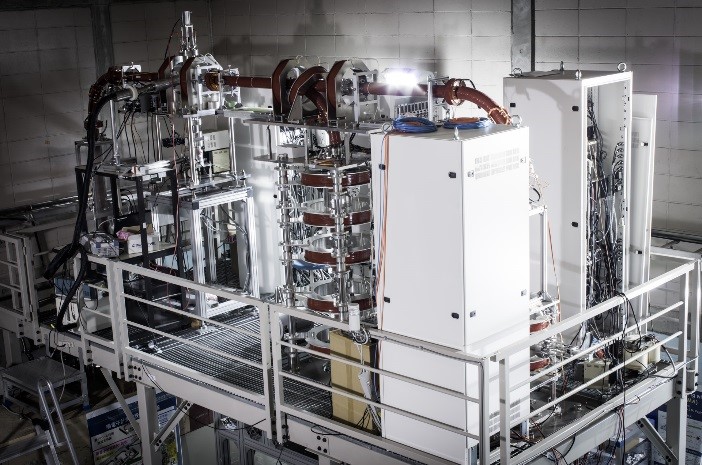
Positron Probe MicroAnalyzer (PPMA)
PPMA is a scanning positron microscope for mapping positron lifetimes in samples. The PPMA uses an intense positron microbeam (beam diameter < 100 μm) generated by an electron linear accelerator. -
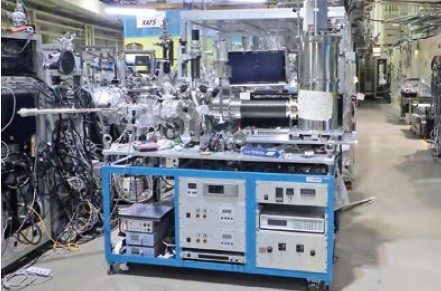
X-ray Absorption Fine Structure Spectroscopy with a Superconducting Fluorescence Detector (SC-XAFS)
SC-XAFS can measure the nanostructure of a light element dopant in a solid sample due to the high flux of synchrotron radiation as X-ray source and precise energy resolution of the superconducting detector. -
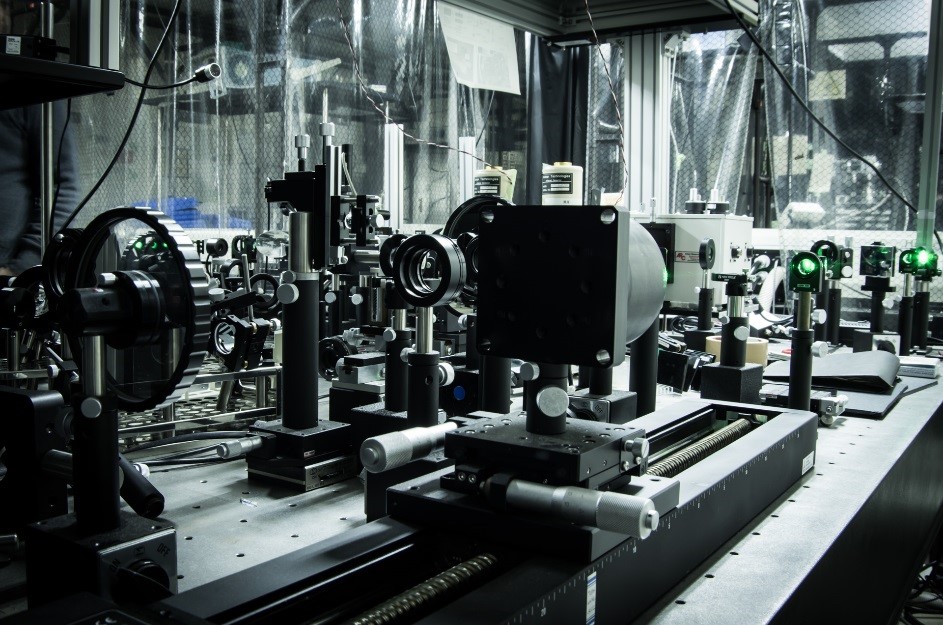
Visible/near-Infrared Transient Absorption Spectrometer (VITA)
VITA is a spectrometer to measure a transient absorption spectrum and luminescence lifetime from the visible to infrared wavelength region.
-
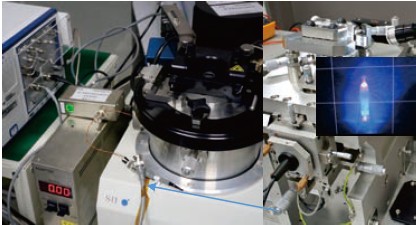
Real Surface Probe Microscope (RSPM)
RSPM system with calibration and sample prep tools, providing KPFM, modulus mapping, and spectroscopic imaging in air, vacuum, and liquid. -
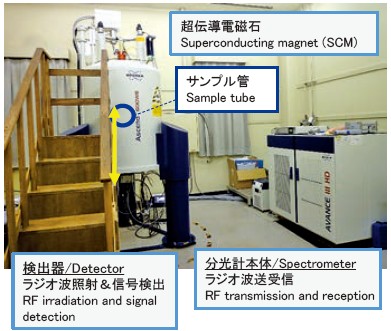
Solid-State Nuclear Magnetic Resonance Spectrometer (SSNMR)
SSNMR is used to measure the local structure and motion of atoms and molecules in solid materials by using atomic nuclear spin as a probe. -
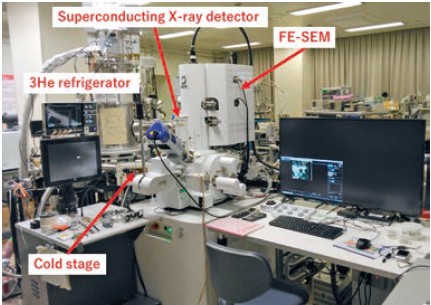
Scanning Electron Microscope with a Superconducting tunnel junction X-ray detector (SC-SEM)
SC-SEM uses a superconducting X-ray detector in SEM-EDX to deliver throughput and <10 eV resolution for nondestructive elemental analysis.