Augmented Living Technology Research Group
Group Member
- Photo
- Position, Name
- Research field

-
Team leader
TANAKA
Hideyuki - High accuracy visual marker, environmental structuring, robot vision, positioning
(Research topic 1) 
- Senior researcher
KAJITANI
Isamu - Myoelectric robotic/prosthetic hands, research on development, evaluation and social implementation of assistive technology
(Research topics 2) 
- Senior researcher
SEKIYAMA
Mamoru - IoT, AAL, functional safety, standardization
(Research topics 3) 
- Senior researcher
OGATA
Kunihiro - Modeling of human body and movement and assistive technology based on it
(Research topic 4) 
- Senior researcher
IZUMI
Konami - Research on fabrication technology of "Wear Device" using flat knitting machines, and development of electric circuit and nuclear magnetic resonance device fabrication using various printing technology on 3D or curved surface
(Research topic 5) 
- Senior researcher
IMAMURA
Yumeko - Assistive technology and its biomechanical analysis
(Research topic 6) -

- Researcher
SHINOZAKI
Masayoshi - Biological characteristics measurement, Design and control of electronic circuits for measuring biological characteristics
(Research topic 7) 
- Researcher
GOTOU
Daisuke - Biosignal and motion sensing using flexible sensors
(Research topic 8) 
- Invited Researcher
OKAMOTO
Shigeo - Data utilization of medical, elderly care and healthcare information

- Technical Staff
TSURUOKA
Toshiyuki - Knit design for various flat knitting machines and knitting for functional knit fabric

- Technical Staff
TOTSUKA
Kenichi - Research and development of assistive devices and care robots
-
- Technical Staff
IHARA
Akinori 
- Technical Staff
TOBE
Sachiko 
- Technical Staff
TAKAHASHI
Naomi -
- Clericular Staff
TSUSHIMA
Keiko

Collaborating Visitors
- Photo
- Name
- Research field (Position)
-
Development and evaluation of assistive robotics and devices
(Professor, Tokyo University of Science, Faculty of Advanced Engineering, Department of Medical and Robotic Engineering Design ) - rehabilitation robot
(Professor, Waseda University, Graduate School of Fundamental Science and Engineering )


Research mission

Resarch topics
1. Lens-Array-Based Variable Moiré Technology for Position, Orientation, and Displacement Measurement
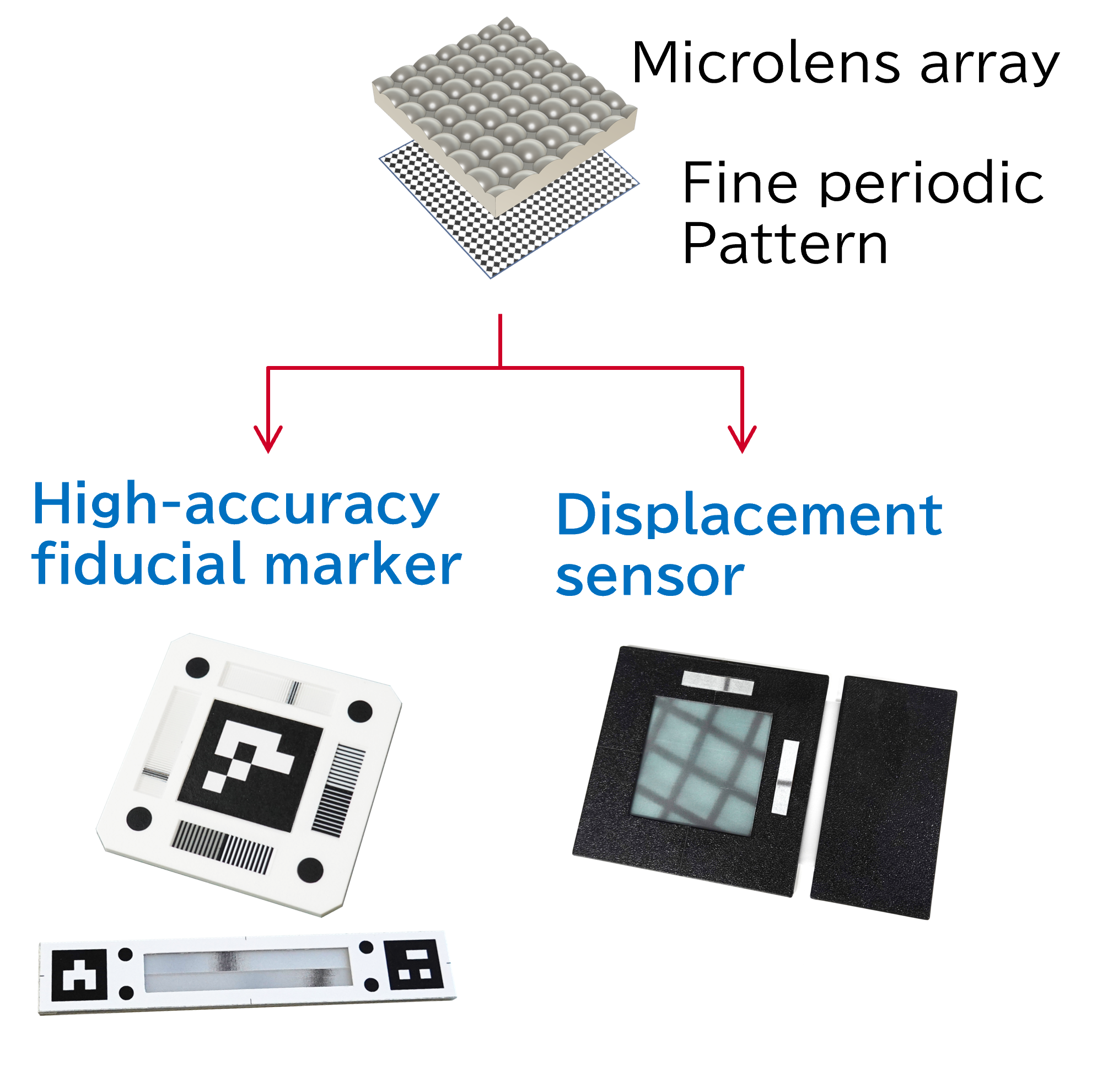
We have developed two types of variable moiré patterns (LEAG and LAMS) generated by combining a microlens array with a fine periodic pattern. Using these technologies, we have developed a high-accuracy marker that enables six-degree-of-freedom (6-DoF) position and orientation measurement with a monocular camera, as well as a displacement sensor that visualizes and measures micron-scale translational and rotational displacements. Through a startup company founded in 2018, we are advancing applications of these technologies in robot control, space development, and various measurement systems. We are also working toward the practical implementation of the displacement sensor for multi-point, long-term monitoring of infrastructure using drones.
(Tanaka)
2. Implementation Research on Assistive Products and Care Technologies for Human and Societal Augmentation
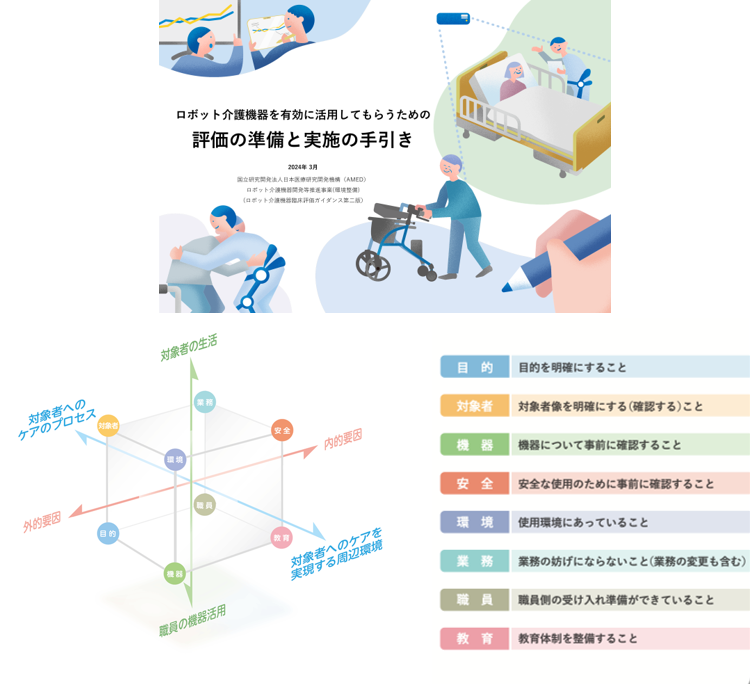
The implementation of new technologies in the welfare and long-term care fields is challenging because it is influenced by a complex interplay of diverse factors. We support developers in designing evaluation plans to build evidence, and conduct analyses to develop implementation strategies for introducing new technologies. We also provide decision-making support and measure implementation outcomes.
Especially Recommended For:
・Researchers Developing New Technologies for the Welfare and Long-Term Care Sectors
・Practitioners and Researchers Interested in Implementing Innovative Technologies in Welfare and Long-Term Care
・Those Seeking Guidance on Developing an Evaluation Plan
(Kajitani)
3. International Standardization of Safety for Interconnected Systems in Smart Homes
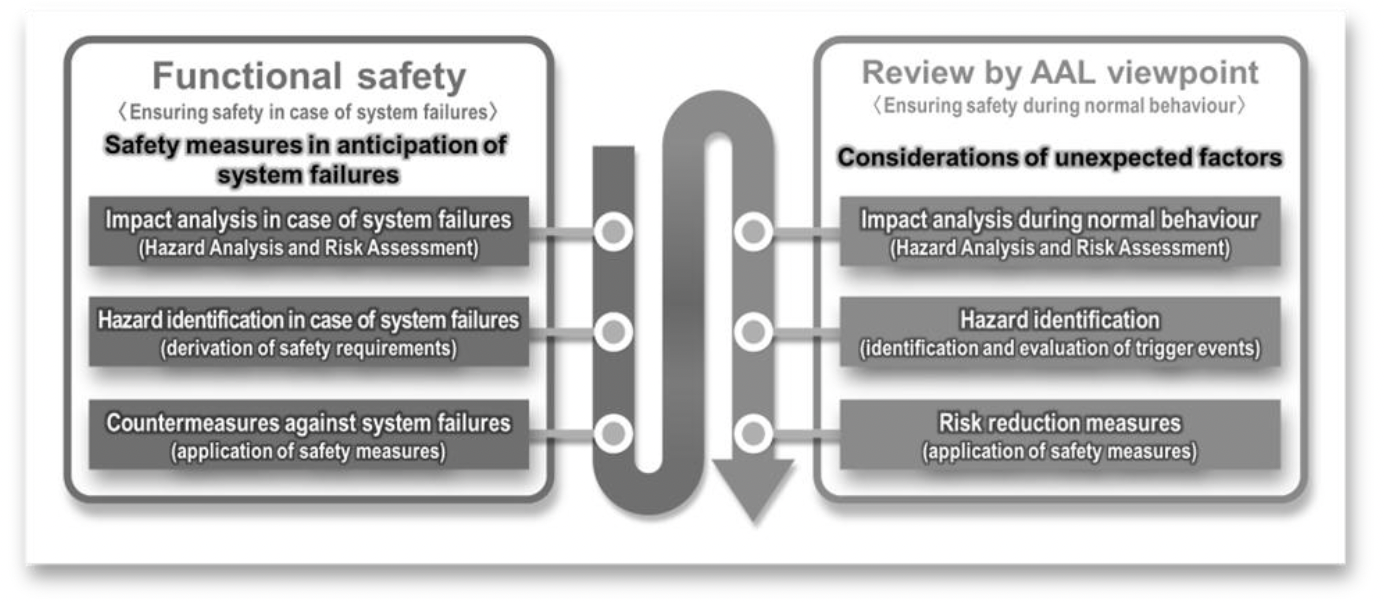
Since 2016, we have been proposing guidelines for the safety of various sensors, IoT devices, smart home appliances and home equipment when they are connected and integrated via home networks as an international standard to the IEC SyC AAL (Active Assisted Living) committee. The acceptable level of risk for in-home integration systems varies depending on the resident’s condition and circumstances (such as age and the presence or absence of disabilities). We are submitting an international proposal—based on consensus among multiple relevant domestic industry organizations—regarding lifestyle support provided by these integrated systems and the approach to determining their acceptable risks.
(Sekiyama)
4. High-Accuracy Visual Marker + XX
We are developing a wide range of applications using high-accuracy fiducial markers. By obtaining highly accurate position and attitude information with a single camera, robot control as well as human movement and motion can be easily and accurately captured as data.
- <Use of a High-Accuracy Marker>
- Proposed Method: Coarse movements are performed manually, while high-accuracy positioning is automated using the marker, achieving both efficiency and accuracy.
- Only Manual Control: Achieving the same level of accuracy (millimeter-level accuracy) using only manual control is too time-consuming.
(Ogata)
5. Research on Knitted Sensors for the Realization of “Wear Devices”
We are conducting research toward the realization of “Wear Devices,” in which clothing itself functions as a device. Ideally, a “Wear Device” should have both “sensing” and “intervention” functions. As a first step, we are conducting research on “Knitted Sensor Wear,” clothing that incorporates sensing functionality.
(Izumi)
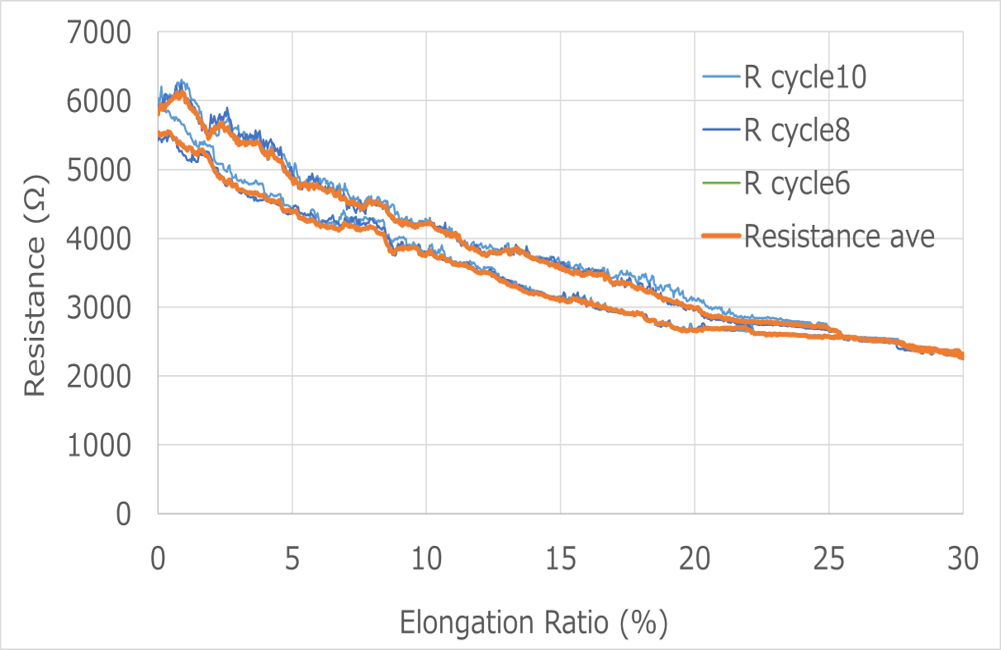
(Right) Basic Characteristics of the Knitted Sensor (Elongation–Resistance Relationship)
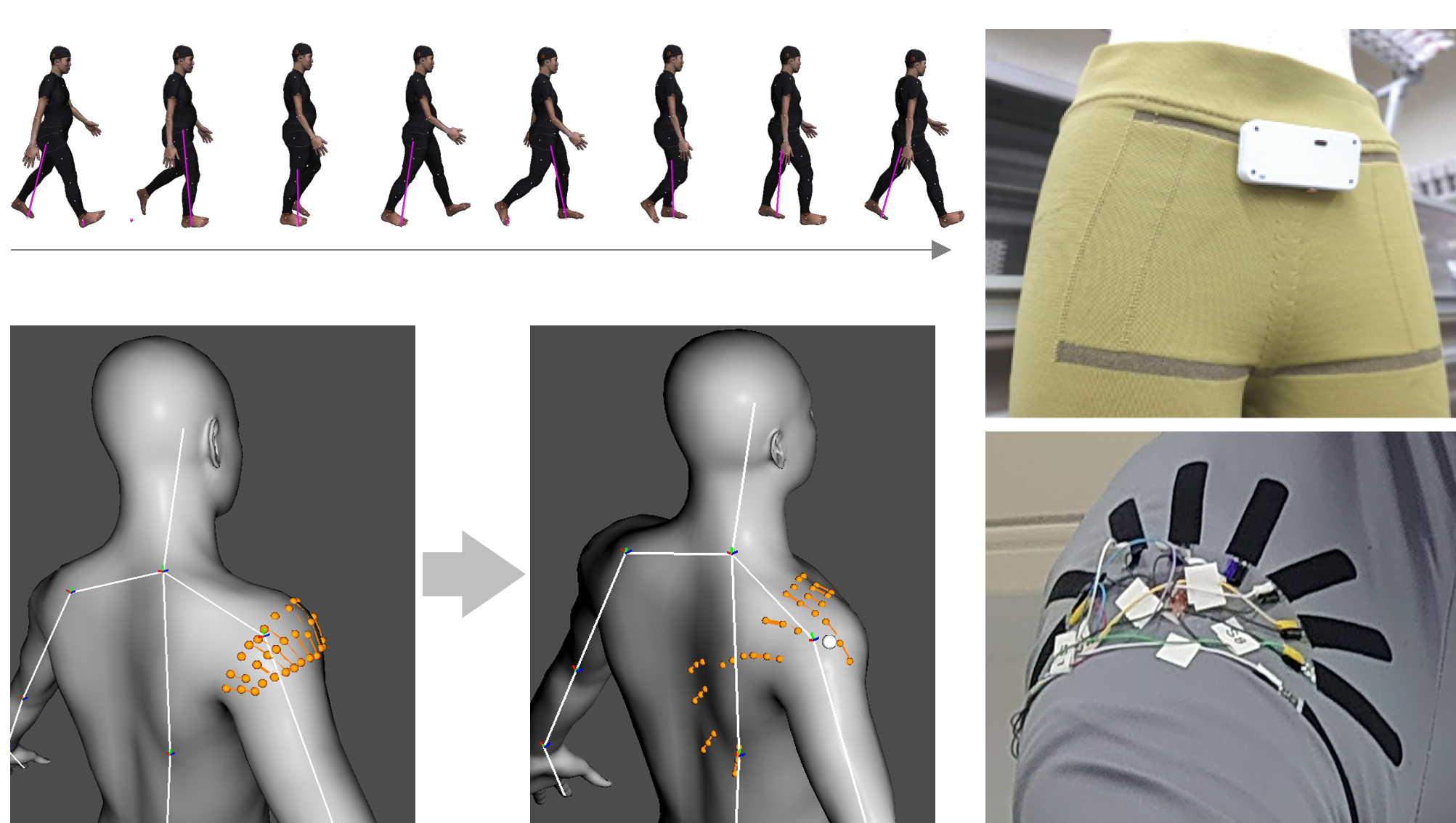
6. Human Motion Analysis and Device Evaluation and Design Using Sensor Wear and Digital Human Models
The condition of blood flow in the extremities, such as the hands and feet, can be measured using light without causing pain. I conduct research on optical measurement technologies and have developed methods for easily assessing impaired blood flow in the extremities and for measuring the contact between a fingertip and an object. I also apply these sensor technologies to the research and development of wearable sensors that can efficiently measure multiple types of physiological information, such as pulse rate and oxygen saturation.
(Imamura)
7. Research on Sensor-Based Measurement Technologies for Monitoring the Human Body
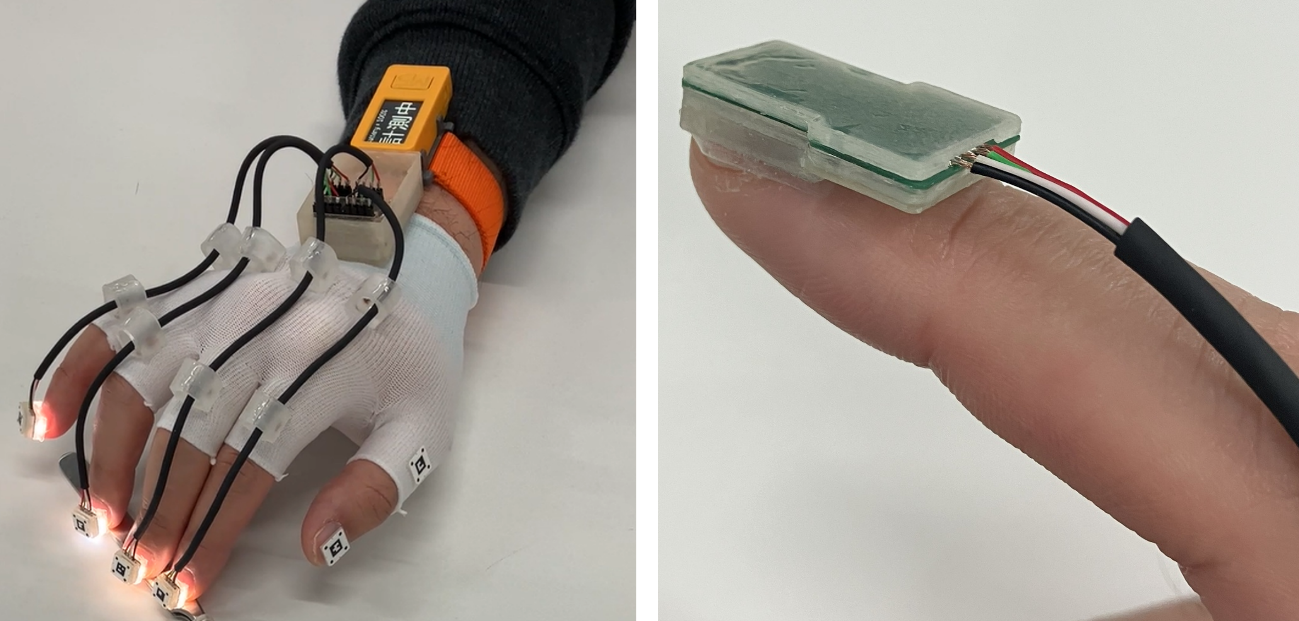
The condition of blood flow in the extremities, such as the hands and feet, can be measured using light without causing pain. I conduct research on optical measurement technologies and have developed methods for easily assessing impaired blood flow in the extremities and for measuring the contact between a fingertip and an object. I also apply these sensor technologies to the research and development of wearable sensors that can efficiently measure multiple types of physiological information, such as pulse rate and oxygen saturation.
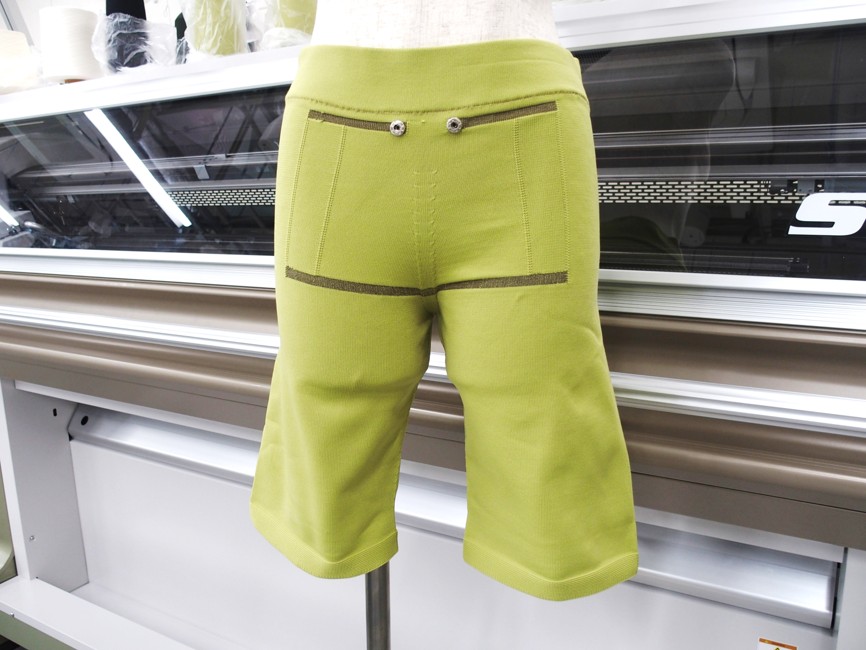
8. Development of Sensor Wear for Comfortable Monitoring of Human Motion and Biosignals
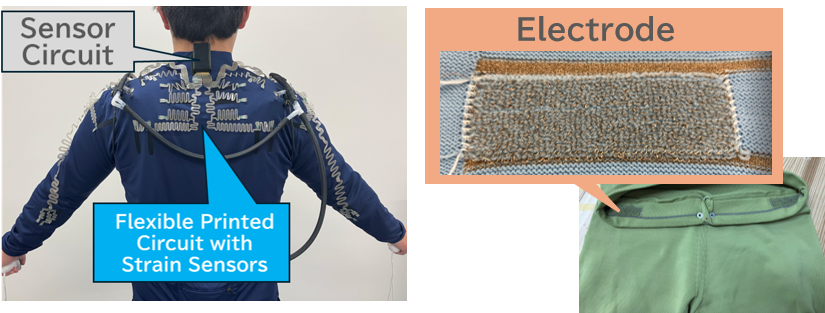
(Right)Soft Knitted Electrode Attached to Pants
We conduct research on wearable sensing technologies that can measure human movement and physiological states simply by wearing clothing. We are developing technologies to capture shoulder girdle motion using flexible printed circuits integrated with multiple strain sensors, as well as biosignal sensing using soft fabric electrodes. We aim to achieve long-term, unobtrusive human monitoring with high wearability and comfort.
(Gotou)
9. Bare finger tactile sensing by using excitation from fingernail
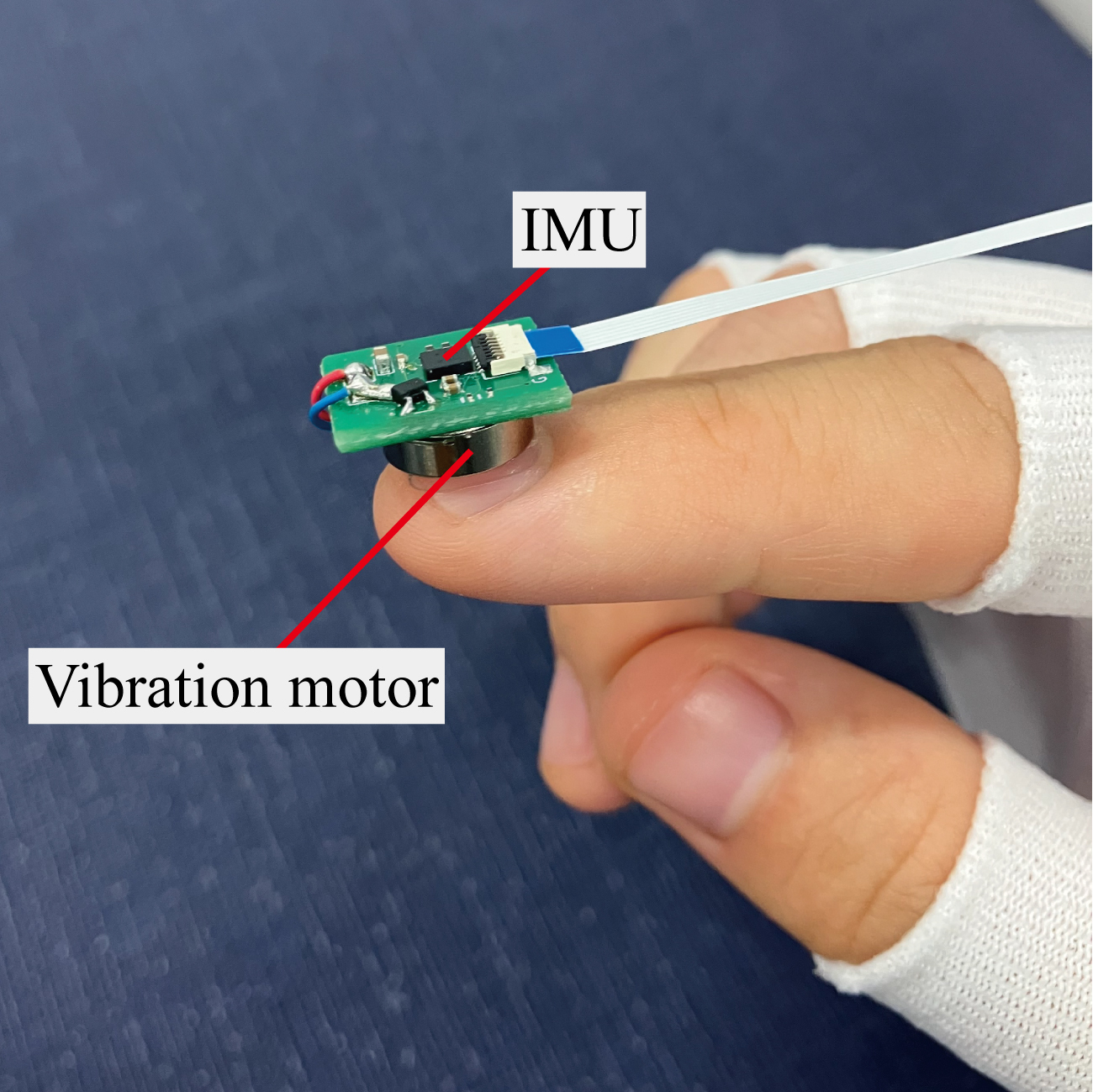
We are working on a tactile sensor that estimates finger contact information without covering the finger pad. Since vibrations applied to the finger through the nail change depending on how the finger contacts an object, machine learning can be used to estimate the contact information from these changes. We aim to realize a technology that captures the tactile information involved in delicate fingertip tasks and enables sharing it between remote locations.
(Kon)
Recent research results
- Chiho Miyazawa, Masayoshi Shinozaki, Yayoi Miwa, Satoshi Karasawa, Taka-aki Nakada, Yukihiro Nomura, Toshiya Nakaguchi
Smartphone-Based Quantitative Measurement of Capillary Refill Time
Instruments, 3 Mar 2026. - Yayoi Miwa, Satoshi Karasawa, Takashi Shimazui, Takehiko Oami, Chiho Miyazawa, Masayoshi Shinozaki, Toshiya Nakaguchi & Taka-aki Nakada
Device-measured capillary refill time identifies critically ill cases in the emergency department
Scientific Reports , 12 Jan 2026. - Kunihiro Ogata, and Hideyuki Tanaka
Real-Time Self-Positioning with the Zero Moment Point Model and Enhanced Position Accuracy Using Fiducial Markers
MDPI Computers 2024, 13(12), 310, 25 Nov 2024. - Masayoshi Shinozaki, Daiki Saito, Keisuke Tomita, Taka-aki Nakada, Yukihiro Nomura & Toshiya Nakaguchi
Usability evaluation of a glove-type wearable device for efficient biometric collection during triage
Scientific Reports, vol.14, Article number: 9874 (2024), 30 Apr 2024.
- J.Ohyama, M.Otsuki, H.Tanaka, K.Watanabe, S.Meguro, S.Miura, I.Hisanaga, K.Isoda, A.Matsuyama, M.Tanaka, S.Niida, N.Tojo, H.Kawanishi, Y.Miura, T.Miyake and M.Mochimaru
"Evaluation of a Concept of Developing Daily Experience Database Using Virtual Proof-of-Concept Experiment in Shopping Use Case"
ICAT-EGVE2024, 3 Dec 2024.
- Hideyuki Tanaka, Kunihiro Ogata,
LeagTag: An Elongated High-Accuracy Fiducial Marker for Tight Spaces
Proc.2024 IEEE Int. Conf. Robotics and Automation (ICRA) 17438-17444, May 2024.
- Hideyuki Tanaka, Kunihiro Ogata,
Fiducial Marker and Camera-Based Passive High-Accuracy 6-DoF Tracking for Mobile Objects
2023 5th International Conference on Control and Robotics (ICCR) 215-220, 23 Nov 2023.