
Perovskite Solar Cells Research Team
Technological Development and Fundamental Research on Perovskite Solar Cells
Overview
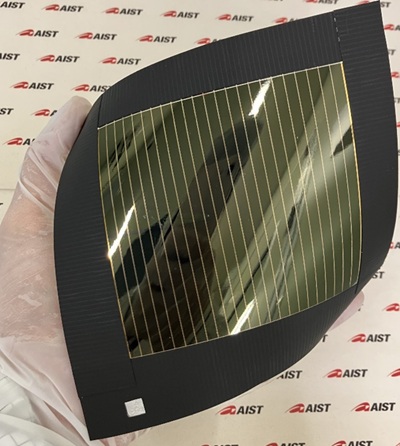
To achieve carbon neutrality by 2050, we must further increase solar power generation. Unlike ordinary solar cells, perovskite solar cells enable the production of lightweight, thin-film solar cells due to their flexibility (Fig.1).
Commercializing lightweight, film-type perovskite solar cells will enable installation in areas with low load-bearing capacity, such as factory roofs, gymnasiums, and carports. Previously, these areas could not support the weight of traditional solar panels.
Additionally, perovskite solar cells' different constituent materials will enable domestic industries to establish a new supply chain. To promote the early commercialization of perovskite solar cells, our research team will utilize our technology and promote innovative research and development to address industrialization issues.
<Related Information>Introduction video for Perovskite Solar Cells Research Team[YouTube 12min](Outbound link)
Objectives
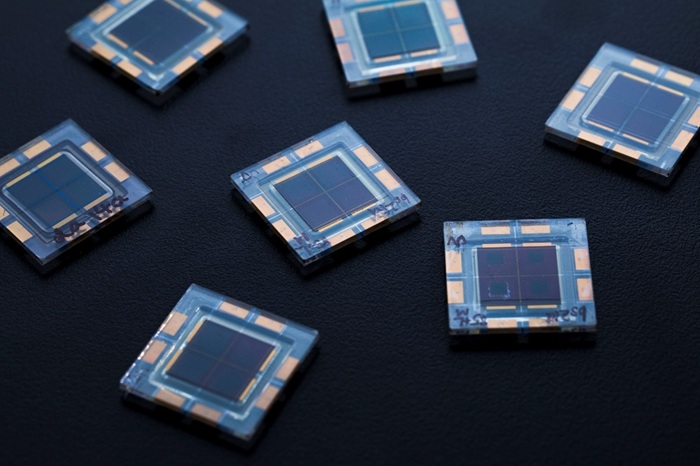
Commercializing perovskite solar cells requires improving durability, developing high-efficiency technologies and mass production processes, and advancing modularization, market development, and international regulations.
Our research team will collaborate with companies and universities to address these issues.
Additionally, we will leverage each team member's strengths to achieve synergistic effects in device fabrication, material development, degradation analysis, device evaluation, and international standardization.
Our goal is to develop technologies that strengthen our group, contribute to the early commercialization of perovskite solar cells, and expand renewable energy by appropriately transferring these technologies to companies.
Main Research Topics and Results
Developing materials to improve the durability of perovskite solar cells
Commercializing perovskite solar cells requires developing technologies for durability, mass production, and evaluation.
Durability issues stem from material properties, and the technical challenge is to protect solar cells from deterioration caused by environmental factors, such as humidity, temperature, light, and oxygen, when installed outdoors.
This would extend the product's life. In particular, since perovskite crystals are ion crystals, they are susceptible to humidity.
Therefore, it is necessary to develop technologies that not only seal the entire solar cell, but also prevent water from entering the solar cell.
Additionally, degradation of the organic hole transport layer is a cause of performance degradation in perovskite solar cells. We are conducting research and development on materials that contribute to the high durability of perovskite solar cells.
This research is being advanced in collaboration with the Research Institute for Energy Conservation in AIST.
Results
We have been developing hole transport materials and additives for perovskite solar cells to improve their durability.
For more information, please refer to the following paper.
<Related Publications>
- 1.N. Nishimura, et.al., Thermally stable phenylethylammonium-based perovskite passivation: spontaneous passivation with phenylethylammonium bis(trifluoromethylsulfonyl)imide during deposition of PTAA for enhancing photovoltaic performance of perovskite solar cells, J. Mater. Chem. A, 2024, 12, 15631-15640, DOI: 10.1039/D4TA02036G
- 2.N. Onozawa-Komatsuzaki, et.al., Short-Step Synthesized Dopant-Free Spiro-Type Hole-Transporting Materials for Efficient and Stable Perovskite Solar Cells, ACS Appl. Energy Mater. 2024, 7, 8, 3082–3090, DOI: 10.1021/acsaem.3c02972
- 3.S. Mathew, et.al., Multifunctional Phosphonic Acid-Based Passivation: A Pathway to Enhance Efficiency and High-Temperature Durability in FAPbI3 Perovskite Solar Cells, ACS Appl. Energy Mater. 2025, 8, 8, 4962–4972, DOI: 10.1021/acsaem.4c02660
- 4.A. Kogo, et.al., Effect of Humidity on Crystal Growth of CuSCN for Perovskite Solar Cell Applications, ChemPhysChem 2023, 24, e202200832, DOI: 10.1002/cphc.202200832
- 5.A. Kogo, et.al., Inverted-Structured Perovskite Solar Cells with a TiO2 Electron-Collector Layer Formed at Room Temperature from Titanium Halide Solutions, ACS Appl. Energy Mater. 2024, 7, 18, 7769–7774, 10.1021/acsaem.4c01226
- 6.H. Kanda, et.al., Mixed 2D-cation passivation towards improved durability of perovskite solar cells and dynamics of 2D-perovskites under light irradiation and at high temperature, Sustainable Energy Fuels, 2025, 9, 247-255, DOI: 10.1039/D4SE01227E
The development of optimisation technologies for high-performance perovskite solar cells using process informatics
Perovskite crystals are made from organic ammonium and lead combined with halogens such as iodine and bromine.
However, their physical properties change depending on the type and ratio of these components, which significantly affects their efficiency and durability.
On the other hand, perovskite crystals can be made from a wide variety of raw materials. It is also necessary to ensure energy band alignment between the perovskite layer and the electron transport layer (which extracts electrons) and the hole transport layer (which extracts holes).
Given the vast number of possible combinations, a significant amount of condition evaluation is required. Typically, researchers have relied on experience and intuition to identify optimal conditions, which is a time-consuming and labor-intensive process.
To address this issue, we are using process informatics (PI) technology to analyze and optimize experimental processes comprehensively, thereby advancing the development of high-durability, high-efficiency perovskite solar cells.
In order to apply PI technology more effectively, we are conducting research to determine which experimental data to extract and how to perform data-driven analyses.
Additionally, to elucidate degradation mechanisms and propose new materials for achieving high durability, we are performing first-principles calculations to analyze molecular reactions and interactions.
We are also promoting the dissemination of PI technology through case studies based on this project.
These studies are being conducted in collaboration with the Material DX Research Centre and the Research Institute of Electrochemical Energy in AIST.
Results
Using PI technology, we have achieved conversion efficiencies that exceed those of perovskite solar cells optimized by researchers' knowledge. For more information, please refer to the following publications.
<Related Publication>N. Eguchi, T. Fukazawa, et.al., Performance optimization of perovskite solar cells with an automated spin coating system and artificial intelligence technologies, EES Sol., 2025, 1, 320-330, DOI: 10.1039/D5EL00007F
Development of an Automatic Perovskite Solar Cell Fabrication System
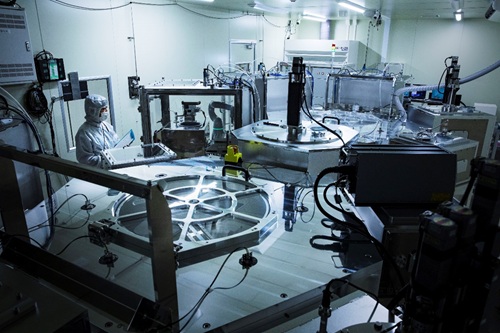
One issue with perovskite solar cells is their low reproducibility. Since perovskite crystallizes in just a few seconds, slight differences in water vapor or film deposition while the perovskite layer is forming can significantly impact the solar cell's characteristics. Consequently, there is significant variation in solar cell performance, making the evaluation of material and process technologies time-consuming. Accurately comparing and evaluating new technologies, however, requires techniques and methods that can quickly and reliably reproduce solar cell characteristics. We have developed an automated cell fabrication system and established facilities for evaluating new technologies with high reproducibility. Specifically, our system automates the entire process: cleaning the transparent electrode substrate, depositing and forming the electron transport layer, the perovskite layer, and the hole transport layer, and vapor-depositing the back electrode. By utilizing these systems, we can reliably evaluate solar cells, support corporate technology development, and contribute to the early industrialization of these technologies.
Results
We have developed an automated system for fabricating perovskite solar cells (Fig.3).
Previously, these cells were produced manually through research. Our system has increased solar cell production by more than tenfold. We announced this achievement in a press release in October 2024, which was written in Japanese and received significant media coverage.
It also generated interest from various organizations in Japan. For more details, please refer to the Japanese press release.
<Related Publication>AIST PRESS RELEASE:World's first automated perovskite solar cell fabrication system developed(2024/10/02)(This page is available only in Japanese.)(Fig.8、9)
Development of Coating and Processing Technologies for the Mass Production of Perovskite Solar Cells
Technology for coating perovskite and other layers is crucial for achieving low-cost mass production.
Many previous reports on perovskite solar cells have used the spin-coating method, a technique that forms a single layer as sheet-by-sheet on each substrate.
In this method, a perovskite raw material solution is spin-coated while an antisolvent is dripped (antisolvent treatment) to form a dense, smooth perovskite crystal layer.
However, it is difficult to use the antisolvent method directly for large-area, continuous layers formation during mass production.
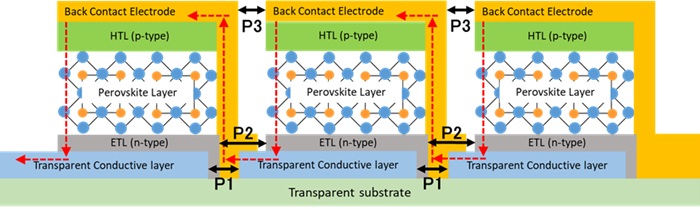
Therefore, technological development is necessary to form dense, smooth perovskite layers without pinholes using continuous film formation methods. Furthermore, modules must be fabricated during mass production to connect large-area perovskite solar cells in series or in parallel (Fig.4).
However, solar cell performance may degrade during module processing. We are developing processing methods to prevent such degradation.
This research is being conducted in collaboration with the Tandem Solar Cell Research Team at our research center and the Core Manufacturing Technology Research Institute at AIST.
Results
We have developed an original continuous film deposition method that can be used for mass production.
Using this method, we achieved the same power conversion efficiency as perovskite solar cells fabricated with the conventional spin-coating method. Furthermore, we achieved a conversion efficiency of over 20% in perovskite solar cells with a cell area of 1 cm2 using our newly developed processing technology.
Elucidation of the Degradation Mechanism of Perovskite Solar Cells
In order to improve the durability of perovskite solar cells, we must first investigate the locations and causes of degradation and then eliminate them.
For instance, we must clarify how each perovskite solar cell component degrades under the influence of heat, light, and humidity. Then, we must develop materials that resist degradation.
We are conducting laboratory experiments, including continuous heating at 85°C, continuous exposure to simulated sunlight, and continuous high-temperature and high-humidity testing at 85°C and 85% humidity.
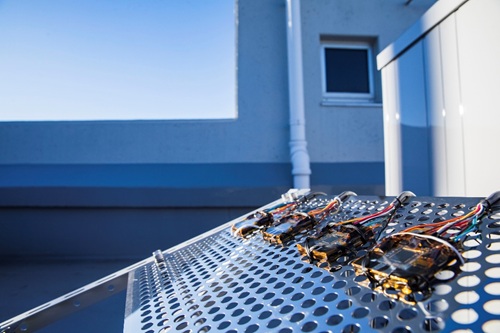
These experiments will help us identify the causes of performance degradation in solar cells. Additionally, we have installed solar cells outdoors to study how degradation caused by actual outdoor environments compares to that caused by accelerated degradation tests conducted in the laboratory (Fig.5).
This research is being conducted in collaboration with the Photovoltaic Calibration, Standards and Measurement Research Team in our research center and the Research Institute for Chemical Process Technology in AIST.
Results
We investigated the effects of heating, humidification, and light irradiation and successfully identified which solar cell materials deteriorated before and after the process.
However, our findings thus far only reveal a small part of the overall deterioration mechanism. We are currently working to elucidate it further. For more information, please refer to the following publications.
<Related publications> N. Nishimura, R. K. Behera, H. Matsuzaki, et.al., Differentiation between bulk and interfacial properties: analysis of time-dependent carrier injection in perovskite solar cells, J. Mater. Chem. C, 2025, 13, 8734-8744, DOI: 10.1039/D5TC00534E
Main Research Facilities
| Research Equipment | Function |
|---|---|
| Perovskite Solar Cell Automatic Fabrication System | It automatically manufactures solar cells. |
| Wavelength and Pulse-Time Tunable Laser Scribing System | Determines processing conditions for solar cell modules. |
| Blade Coater | It can also determine conditions for continuous film deposition suitable for mass production. |
| Spin Coater | It can deposit materials using a sheet-fed method. |
| Vacuum Heating Evaporation Deposition System | It can perform vacuum heating and evaporation of metals and materials. |
| Solar Simulator | It can irradiate with simulated sunlight and measure conversion efficiency. |
| External Quantum Efficiency Spectrometer | Measure the ratio of electrons generated to the number of photons incident on the solar cell, broken down by irradiation wavelength. |
| Large-Scale Light Irradiation Test System | Perform long-term simulated sunlight irradiation photodegradation testing on 1200 mm2 solar cell modules. |
| Large-Scale Light Beam Induced Current Measurement System (LBIC) | Performs power generation mapping within 1200 mm2 solar cell modules. |
| Heating + Humidification + Simulated Sunlight Irradiation Testing Machine. | Perform accelerated aging testing on solar cells. |
| Scanning Electron Microscope with STEM | Perform morphological observations of solar cells. |
| Atomic Force Microscope | It can also perform morphological observations of materials and measure electrostatic interactions. |
| X-ray Diffraction Device (Heating Stage, GIWAX-equipped) | Observe the state of perovskite crystals, etc. |
| GD-OES | Determine the depth distribution of elements constituting materials. |
| Ionization Potential Measurement Device | Measure the HOMO and valence band levels of organic materials. |
| Dry Room | Fabricate solar cells in a low-humidity environment of 1% or less. |
Team Member
| Title | Name |
|---|---|
| Leader, Team | MURAKAMI Takurou |
| Senior Researcher | ONOZAWA Nobuko |
| Senior Researcher | KOGO Atsushi |
| Senior Researcher | NISHIMURA Naoyuki |
| Senior Researcher | YAMAMOTO Kohei |
| Researcher | EGUCHI Naoto |
| Attached to Research Center | CHIKAMATSU Masayuki |
| Attached to Research Team | YOSHITA Masahiro |
| Attached to Research Team | TAYAGAKI Takeshi |
| Attached to Research Team | KANDA Hiroyuki |